
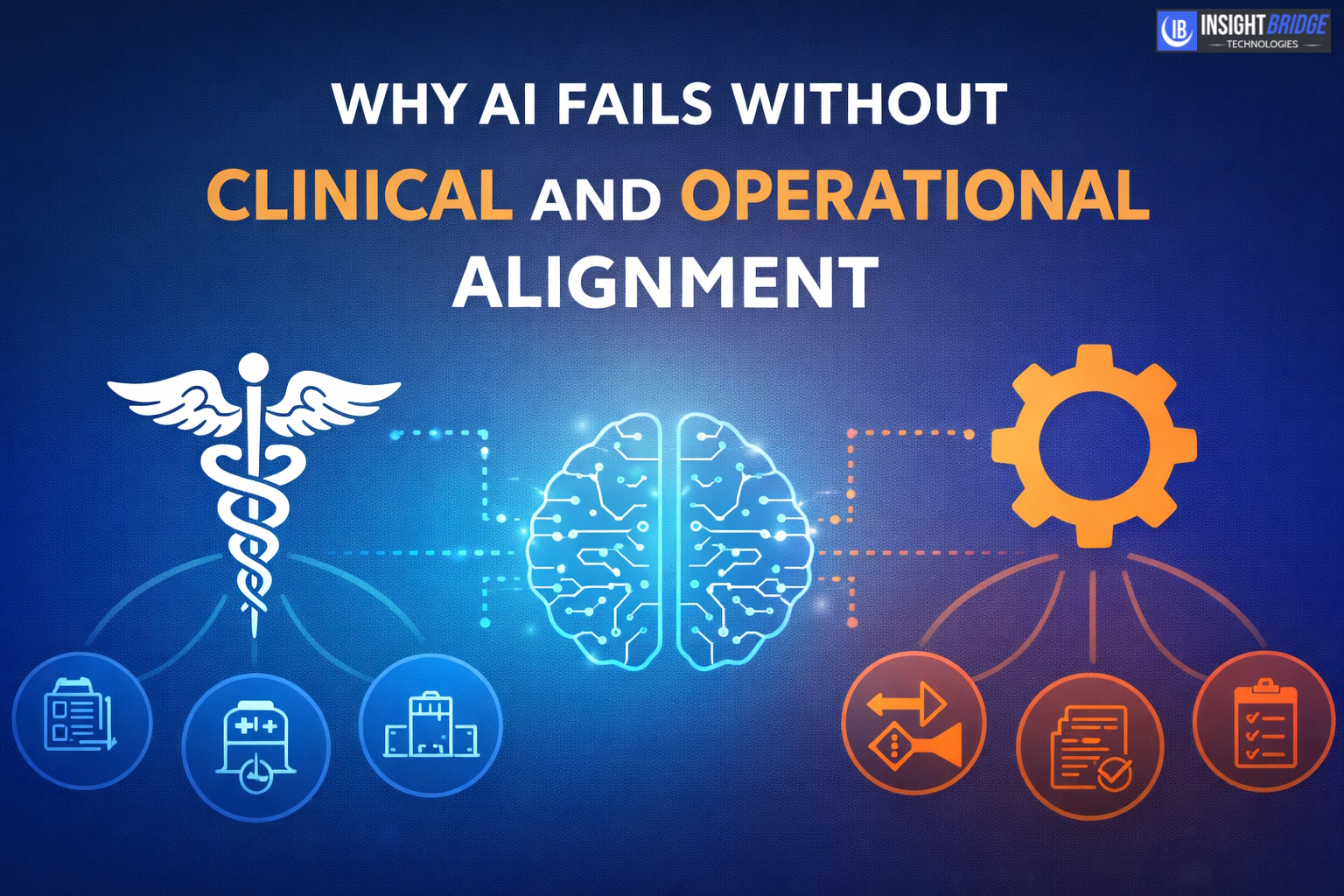
Why AI Fails Without Clinical and Operational Alignment
AI is often positioned as a breakthrough technology.
Smarter algorithms.
Faster insights.
Automated decision-making.
Yet many AI initiatives fail to deliver meaningful value — even when the technology works.
The reason is rarely the model.
It’s misalignment.
The AI Assumption Problem
Organizations often assume that if an AI model performs well in a pilot, it will naturally deliver value at scale.
But AI does not operate in isolation.
It depends on:
- Clinical workflows
- Operational processes
- Data integrity
- Decision authority
When those elements are misaligned, AI amplifies confusion instead of clarity.
Where AI Breaks Down in Practice
Several patterns appear repeatedly across healthcare and enterprise environments.
Clinical workflows aren’t designed for AI output
Insights arrive, but no one owns the next step.
Recommendations are generated, but not trusted or acted upon.
Operational processes lag behind intelligence.
AI flags risks, inefficiencies, or opportunities — but escalation paths are unclear.
Decisions stall because roles and responsibilities were never defined.
Data reflects inconsistency
AI learns from existing behavior.
If workflows, documentation, and standards vary, AI reproduces that variability at scale.
Accountability is missing
When AI decisions are questioned, ownership disappears.
Without accountability, adoption erodes quickly.
Why Better Models Don’t Fix This
AI is not a substitute for alignment.
No algorithm can:
- Resolve unclear ownership
- Fix broken workflows
- Create trust where governance is absent
- Replace leadership accountability
AI accelerates what already exists — good or bad.
What Aligned Organizations Do Differently
Organizations that succeed with AI establish alignment before expanding capability.
They:
- Define where AI fits into clinical and operational workflows
- Clarify decision rights tied to AI-generated insights
- Standardize data inputs and documentation practices
- Establish governance for validation, escalation, and accountability
AI becomes a decision-support capability—not a decision-avoidance mechanism.
The InsightBridge Perspective
At InsightBridge, we see AI succeed when alignment comes first.
When clinical, operational, and leadership teams are aligned, AI accelerates outcomes.
When they aren’t, AI exposes gaps more quickly.
Leadership Takeaway
AI does not create alignment.
It reveals whether alignment already exists.
Roberto
Generally I do not read post on blogs, but I wish
to say that this write-up very forced me to try and do it!
Your writing taste has been surprised me. Thanks,
quite nice post.
My web blog: read more