
Enterprise imaging initiatives are often positioned as technology programs.
Health systems implement:
- Vendor Neutral Archives (VNA)
- Enterprise viewers
- Cross-specialty image storage platforms
These investments are intended to break down imaging silos and improve clinical access to visual data.
The technology is important.
But technology alone does not create enterprise imaging.
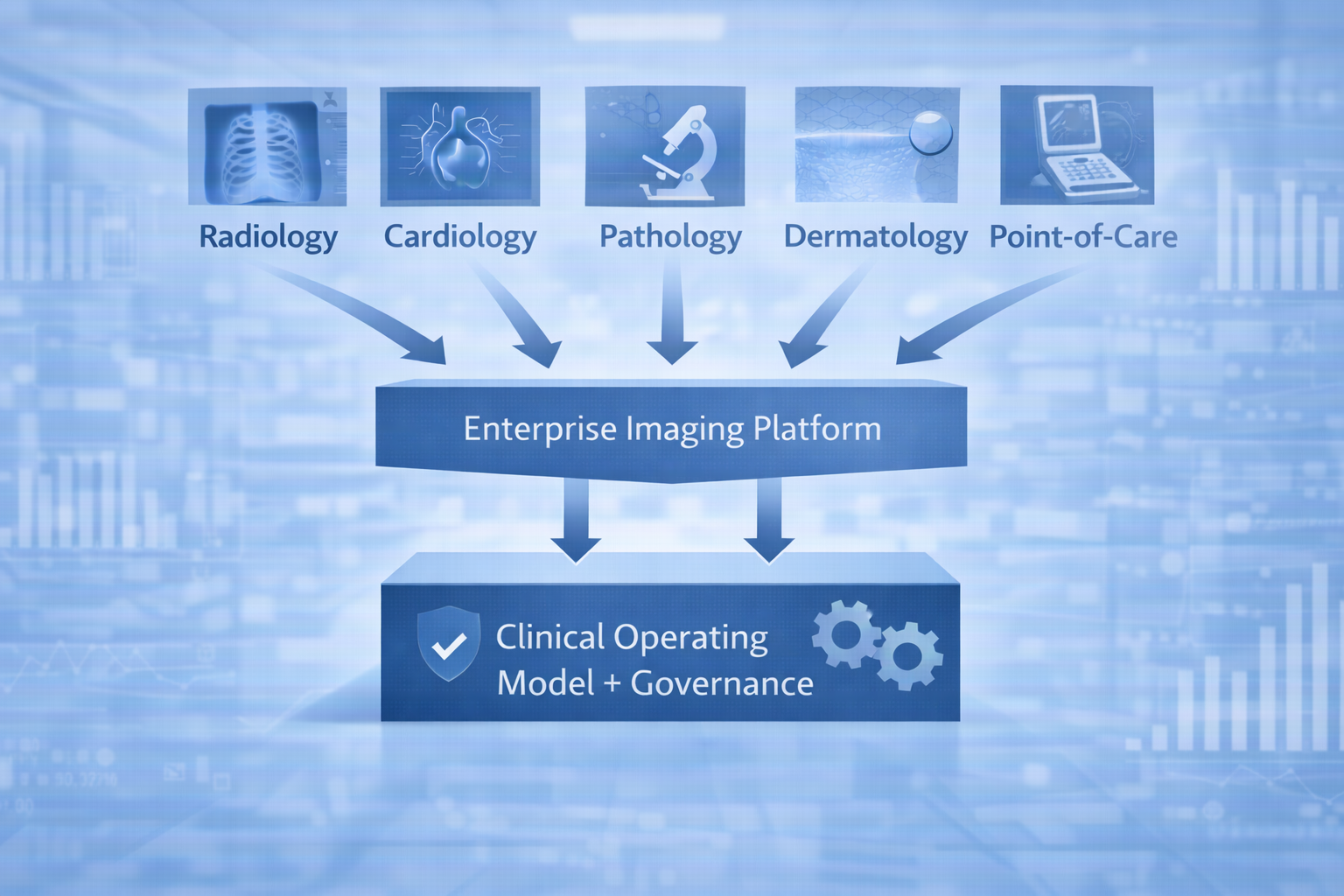
Enterprise imaging requires a clinical operating model.
The Infrastructure Assumption
Many organizations treat enterprise imaging as an infrastructure problem.
Images are consolidated into a shared platform.
Legacy archives are retired.
Enterprise viewers are deployed.
The assumption is that once the technology is in place, clinical adoption will follow naturally.
In reality, clinical workflows remain specialty-driven.
Radiology, cardiology, dermatology, pathology, and point-of-care imaging each operate within their own clinical processes.
Without operational alignment, enterprise imaging becomes shared infrastructure without shared workflows.
Where Programs Begin to Struggle
When enterprise imaging lacks a clinical operating model, common challenges emerge:
- Clinicians continue relying on specialty-specific viewers
- Imaging data remains inconsistently structured
- Cross-specialty collaboration remains limited
- Enterprise viewers become underutilized
- Imaging AI initiatives struggle to access consistent datasets
The technology works.
The clinical system does not fully change.
Why Clinical Alignment Matters
Imaging plays an increasingly central role in patient care.
Clinical teams depend on visual information to support diagnosis, treatment planning, and monitoring.
When enterprise imaging succeeds, clinicians gain:
- longitudinal patient imaging records
- consistent viewing experiences across specialties
- easier collaboration between care teams
- improved access to imaging data during care transitions
Achieving this requires more than infrastructure.
It requires coordinated clinical workflows.
What Successful Organizations Do Differently
Health systems that realize the full value of enterprise imaging treat it as a clinical transformation effort.
They establish:
- cross-specialty clinical governance
- standardized imaging workflows
- enterprise metadata and indexing standards
- shared viewing strategies across specialties
- coordinated policies for image lifecycle management
Technology supports the system.
Clinical alignment defines how the system works.
The InsightBridge Perspective
We frequently see organizations invest in enterprise imaging infrastructure while clinical workflows remain unchanged.
This creates a gap between technical capability and operational value.
Enterprise imaging succeeds when governance, clinical workflows, and technology evolve together.
Leadership Takeaway
Enterprise imaging is not only a technology architecture.
It is a clinical operating model.
Organizations that recognize this early unlock far greater value from their imaging investments.