
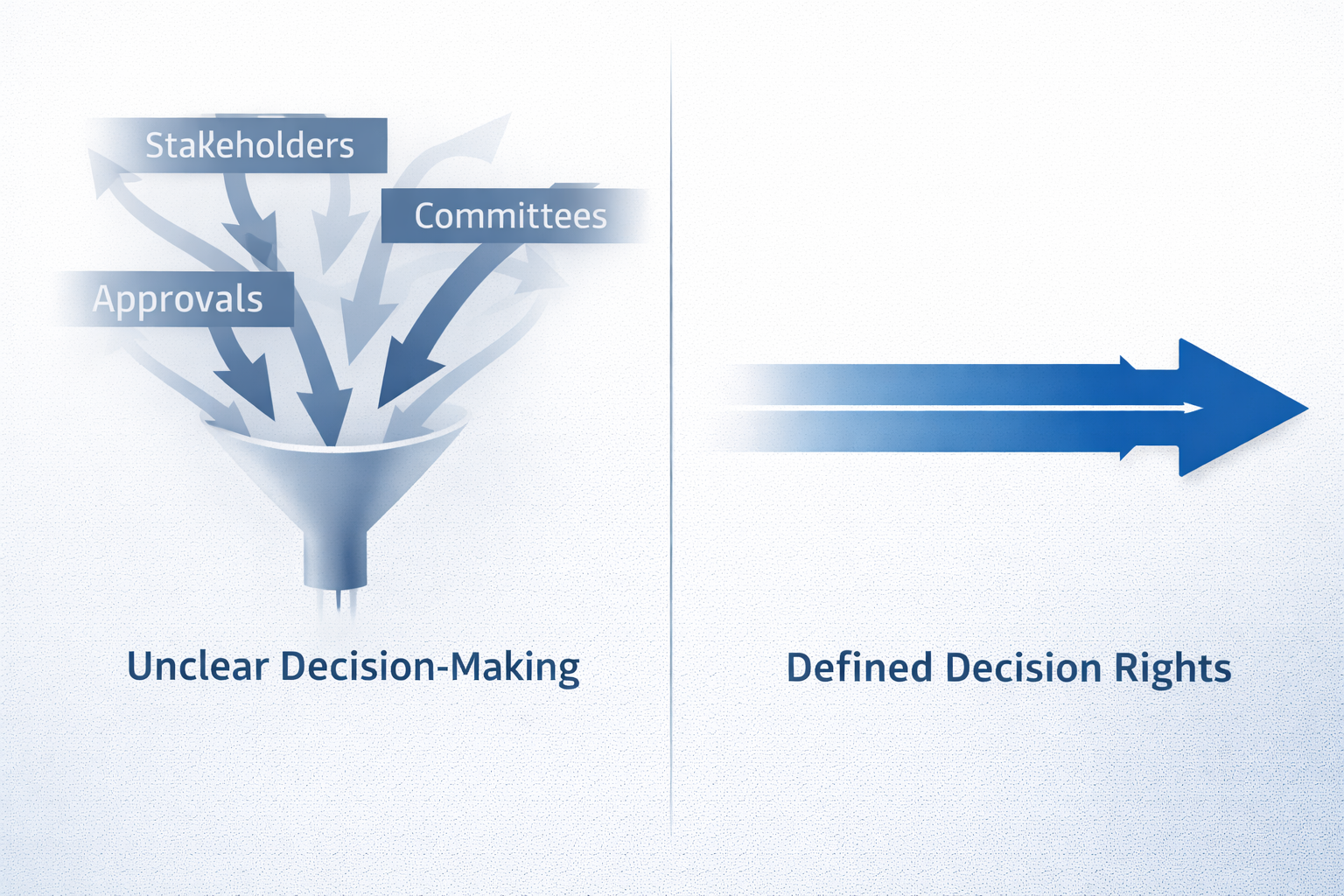
Most transformation challenges don’t originate in strategy.
They emerge in decision-making.
Priorities shift.
Timelines slip.
Dependencies stall.
Not because the work is unclear.
Because decisions are.
The Hidden Friction
In many healthcare organizations, decision-making is:
Distributed across committees
Influenced by competing stakeholders
Delayed by the need for alignment
On the surface, this appears collaborative.
In practice, it creates friction.
Teams wait.
Escalations increase.
Momentum slows.
Execution doesn’t fail.
It stalls.
Why Decision Clarity Matters
Every transformation initiative depends on a continuous flow of decisions:
What takes priority
What gets funded
What gets delayed
What gets standardized
When decision rights are unclear:
Work moves forward unevenly
Teams operate on assumptions
Rework increases
The organization appears active.
But progress is inconsistent.
The Cost of Ambiguity
Unclear decision-making leads to:
Delayed execution without visible blockers
Conflicting priorities across teams
Increased reliance on escalation
Reduced accountability for outcomes
Over time, this creates a pattern:
Execution depends on individuals — not the system.
What High-Performing Organizations Do Differently
Organizations that execute effectively:
Define decision rights explicitly
Separate input from authority
Establish escalation paths that resolve — not delay
Align decision-making with operating model structures
Make decisions visible across the organization
They understand that speed is not about urgency.
It is about clarity.
The InsightBridge Perspective
We often see transformation efforts supported by strong strategy and capable teams.
But without clear decision frameworks, execution becomes dependent on informal alignment.
This introduces variability.
And variability limits scale.
Leadership Takeaway
Execution does not slow down because organizations lack the capability.
It slows because decisions lack clarity.
Organizations that define how decisions are made — and who makes them — execute with consistency.