
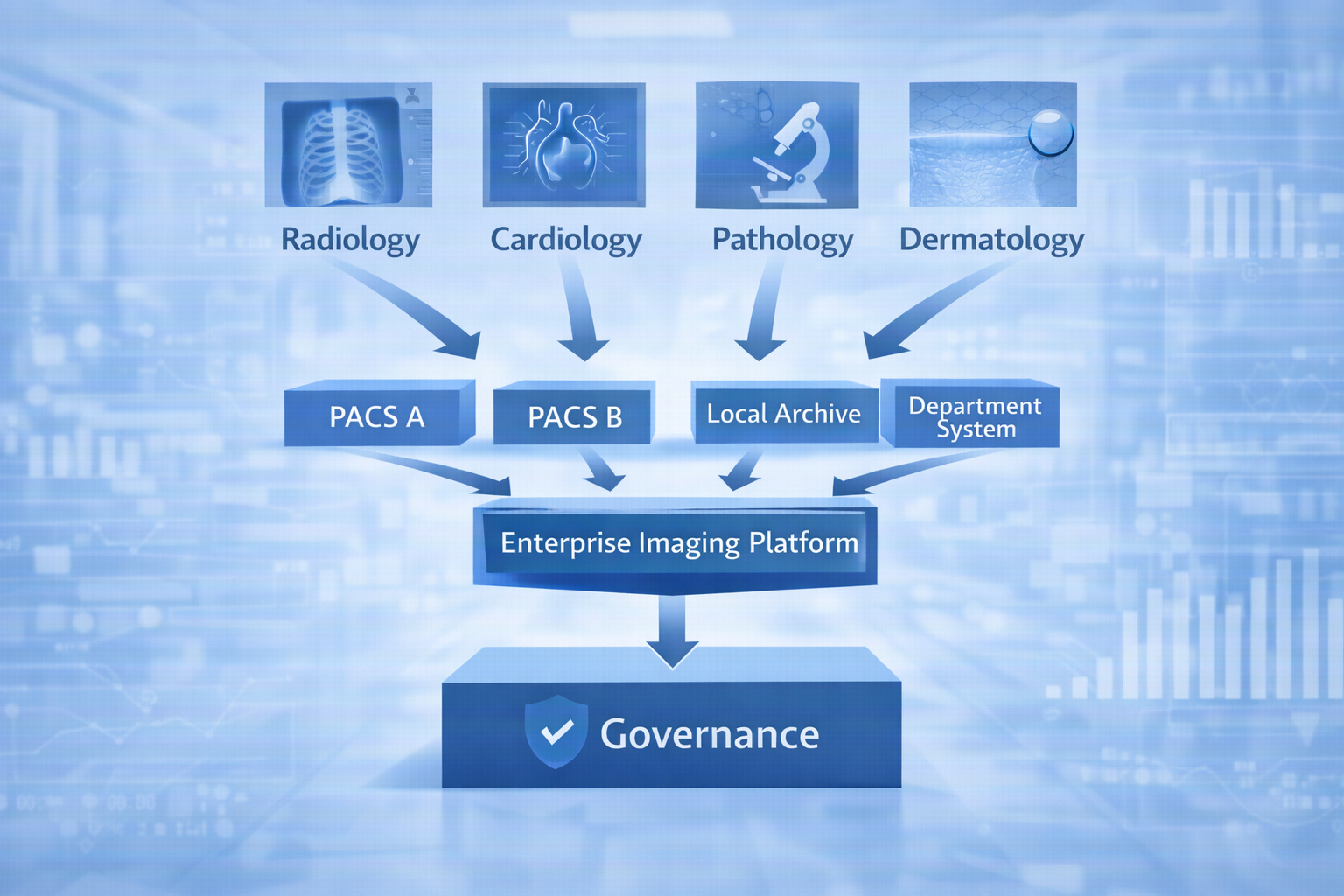
Healthcare organizations generate enormous volumes of clinical imaging.
Radiology studies.
Cardiology imaging.
Pathology slides.
Dermatology photos.
Point-of-care imaging.
Yet in many health systems, these images remain fragmented across multiple platforms.
The result is not simply technical complexity.
It is operational inefficiency.
The Persistence of Imaging Silos
Historically, imaging evolved within specialty departments.
Radiology implemented PACS.
Cardiology deployed cardiovascular imaging systems.
Other specialties adopted their own tools and workflows.
Each environment was optimized for local needs.
Over time, these systems became deeply embedded in departmental operations.
What worked locally created fragmentation at the enterprise level.
The Operational Impact
Imaging silos create hidden costs that often go unnoticed.
Organizations frequently experience:
- Duplicate image storage across systems
- Inconsistent patient identifiers and metadata
- Limited image accessibility across specialties
- Workflow disruptions during patient transitions of care
- Increased integration and maintenance overhead
These inefficiencies accumulate gradually.
The organization adapts to the complexity rather than resolving it.
Why Consolidation Alone Is Not Enough
Many health systems pursue enterprise imaging to address fragmentation.
Platforms are consolidated.
Vendor-neutral archives are implemented.
Enterprise viewers are introduced.
These initiatives improve technical alignment.
But silos can persist operationally if governance does not evolve alongside technology.
Departments may still define:
- their own metadata standards
- their own workflows
- their own image lifecycle policies
Without governance, enterprise imaging becomes a shared infrastructure without shared operating principles.
The Strategic Opportunity
When imaging silos are addressed effectively, organizations unlock significant value:
- Longitudinal patient imaging records
- Cross-specialty clinical collaboration
- Reduced storage redundancy
- Simplified AI deployment across imaging domains
- Improved clinical decision-making
Enterprise imaging becomes more than a technology platform.
It becomes a clinical data strategy.
The InsightBridge Perspective
We often see healthcare systems invest in enterprise imaging platforms while legacy operational structures remain unchanged.
Technology integration is achieved.
Operational integration is not.
Sustained value emerges only when imaging governance aligns clinical workflows, data standards, and enterprise priorities.
Leadership Takeaway
Imaging silos are rarely visible on organizational charts.
But they shape how information flows across the health system.
Breaking down imaging silos requires more than technology.
It requires enterprise governance and cross-specialty alignment.