
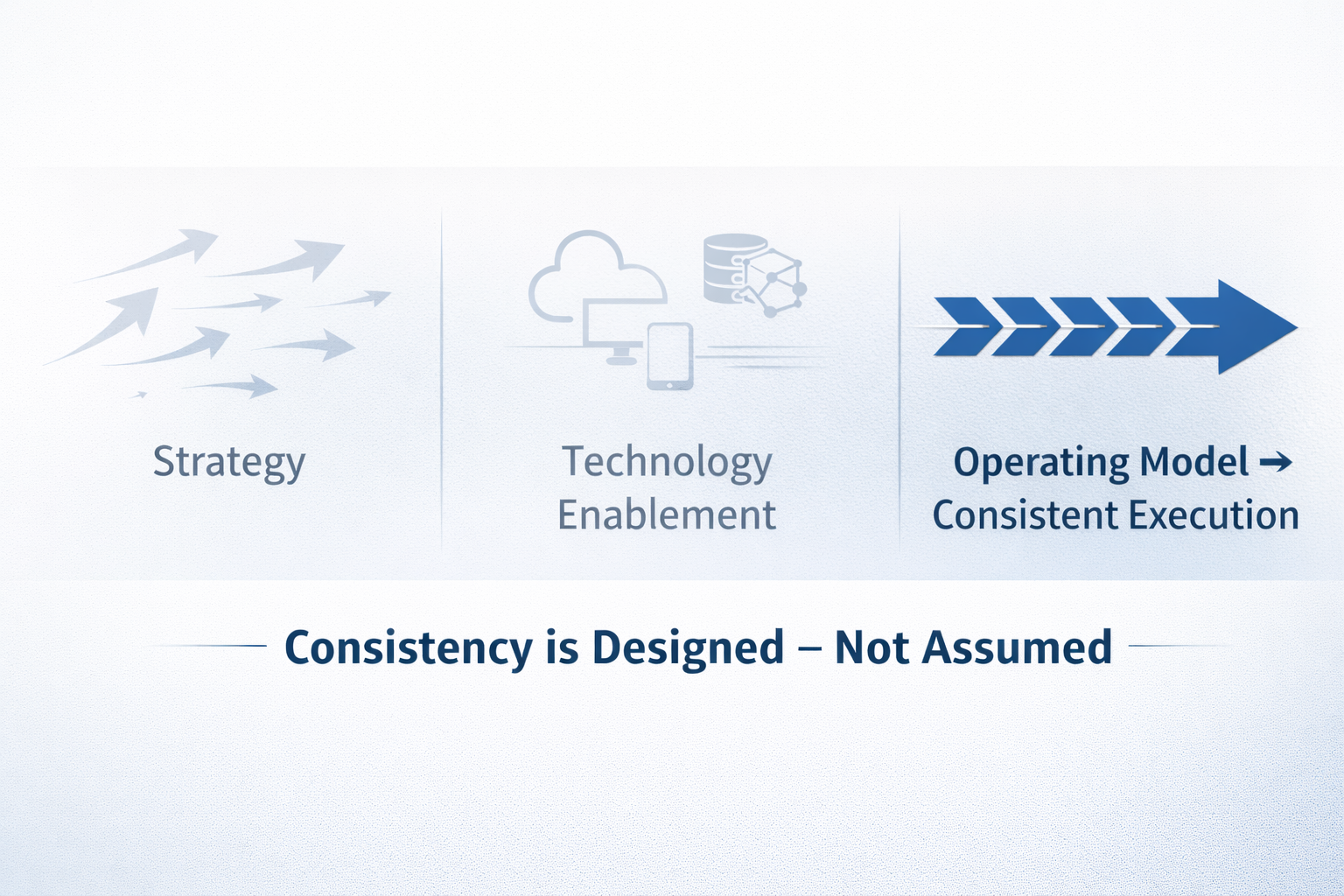
Most healthcare organizations don’t struggle with strategy.
They struggle with execution consistency.
Initiatives are launched with clarity.
Roadmaps are defined.
Technologies are selected.
Yet outcomes vary.
Not because the strategy was flawed.
But because execution is inconsistent across the organization.
This is not a technology issue.
It is an operating model issue.
The Hidden Constraint
Transformation efforts often assume that once direction is clear, execution will follow.
In reality, execution depends on how the organization operates day to day:
How decisions are made
How priorities are managed
How accountability is enforced
How work is coordinated across teams
Without a defined operating model, execution becomes fragmented.
Different teams interpret priorities differently.
Standards vary across domains.
Dependencies are managed reactively.
The result is not failure.
It is inconsistent.
What an Operating Model Actually Does
An effective operating model creates alignment at scale.
It defines:
Clear decision rights
Standardized ways of working
Governance structures tied to execution
Roles and accountability across functions
It ensures that strategy is not just communicated — it is consistently executed.
Why Technology Alone Doesn’t Scale
Organizations often attempt to solve execution challenges through:
New platforms
Automation tools
Additional reporting
But technology amplifies existing conditions.
If execution is inconsistent, technology accelerates inconsistency.
If alignment is strong, technology scales it.
What High-Performing Organizations Do Differently
Organizations that execute consistently:
Align operating models with strategic priorities
Define decision-making frameworks across domains
Standardize execution processes where it matters
Embed governance into daily operations
Measure consistency — not just outcomes
They recognize that execution discipline is designed, not assumed.
The InsightBridge Perspective
We frequently see healthcare organizations invest heavily in transformation while operating models remain undefined or fragmented.
The result is predictable:
Strong strategy
Capable teams
Inconsistent execution
Transformation success is not determined by intent.
It is determined by how the organization operates under pressure.
Leadership Takeaway
Strategy sets direction.
Technology enables capability.
Operating models determine whether execution is consistent.
And consistency is what ultimately drives outcomes.