

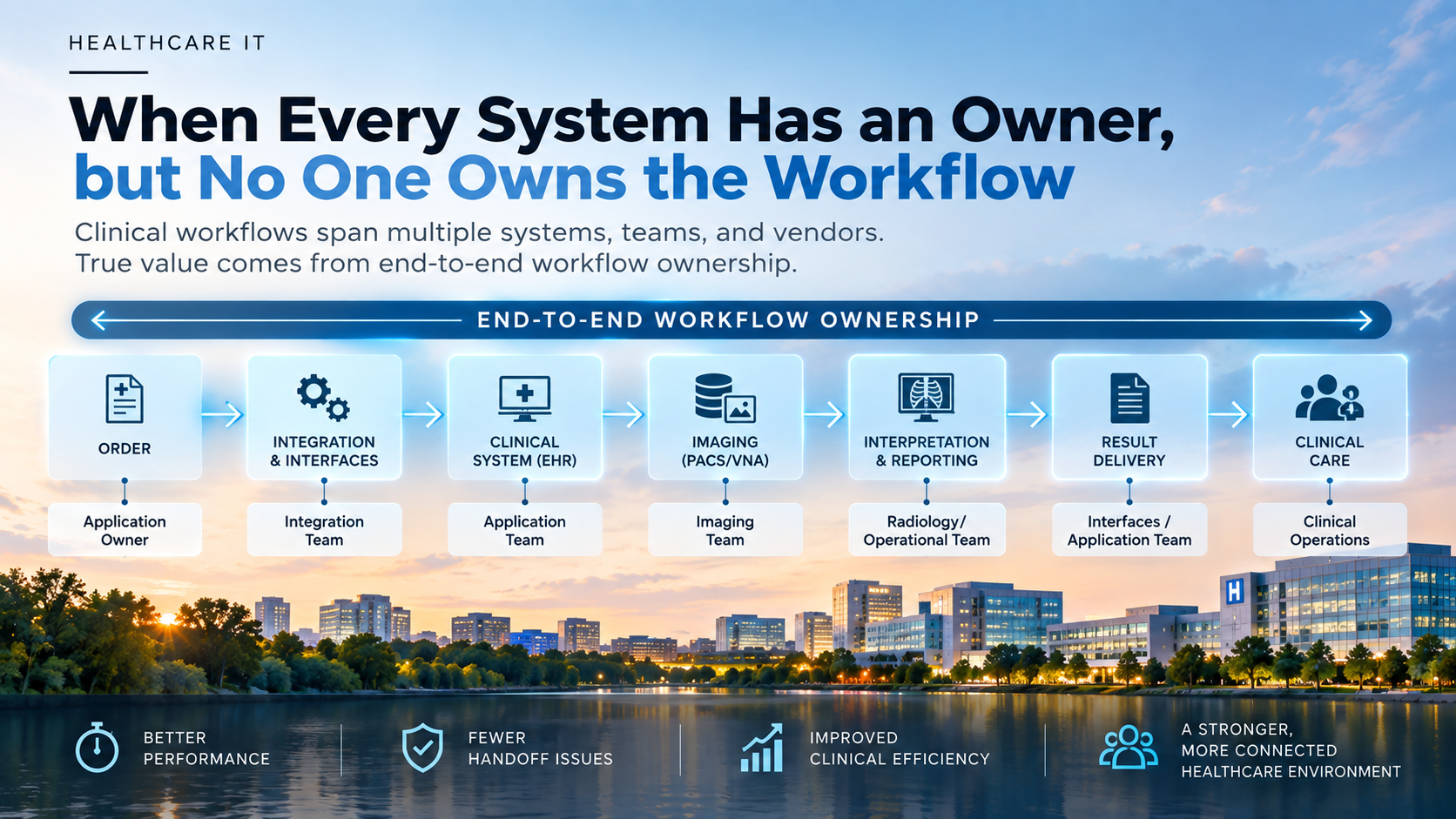
Healthcare organizations are generally good at assigning ownership to technology.
The EHR has an application owner.
PACS has an imaging team.
Interfaces have an integration team.
Infrastructure has an operations team.
Cybersecurity has security leadership.
Vendors have account managers and support teams.
On paper, ownership appears clear.
But when a clinical workflow crosses all of those systems, something different can happen.
Every system has an owner, but no one owns the workflow.
And that gap can become one of the most persistent sources of operational friction in healthcare IT.
Clinical Workflows Do Not Follow Organizational Charts
Consider a relatively simple imaging workflow.
An order originates in the EHR.
Patient and order information moves through an interface.
The study reaches an imaging modality.
Images are transmitted to PACS or a VNA.
A radiologist interprets the study.
A report moves back into the clinical record.
Results may then trigger additional communication, follow-up, or downstream action.
From the clinician’s perspective, this is one workflow.
From the technology organization’s perspective, it may involve several applications, teams, vendors, interfaces, and support structures.
Each component can technically be functioning while the overall workflow still performs poorly.
That is where traditional system ownership begins to show its limits.
Local Optimization Can Create Enterprise Friction
Individual teams are often measured on the performance of the systems they manage.
Infrastructure focuses on availability.
Application teams focus on application performance.
Integration teams focus on message delivery.
Vendors focus on contractual service levels.
Support teams focus on ticket resolution.
Those measures matter.
But none necessarily answers the larger question:
Did the workflow work for the person trying to deliver care?
A system can meet its SLA while clinicians experience delays.
An interface can successfully deliver a message while the receiving application handles it incorrectly.
A ticket can be closed while the underlying workflow problem remains.
Each team may be doing its job correctly.
Yet the organization can still be producing a poor outcome.
The Handoff Is Often Where the Problem Lives
Many difficult technology problems do not exist entirely inside one application.
They exist between applications.
Between teams.
Between vendors.
Between technical and operational ownership.
One team investigates and determines that its system is functioning normally.
The issue moves to another team.
That team reaches the same conclusion.
Then another vendor becomes involved.
The ticket moves.
The workflow problem remains.
This is why complex healthcare technology environments need more than component-level accountability.
They need end-to-end workflow accountability.
Workflow Ownership Changes the Question
System ownership asks:
Is my system working?
Workflow ownership asks:
Is the entire process producing the intended outcome?
That distinction changes how problems are investigated.
Instead of stopping when individual components appear healthy, teams examine the complete chain:
Where did the workflow begin?
What information moved?
Which systems transformed it?
Where did latency occur?
Where was context lost?
What manual intervention became necessary?
What did the clinician experience?
Did the process ultimately achieve the expected result?
That perspective prevents organizational boundaries from becoming troubleshooting boundaries.
Ownership Does Not Mean One Team Controls Everything
End-to-end workflow ownership does not require moving every application under one department.
Nor does it mean creating another layer of management.
It means establishing clear accountability for the performance of the workflow across organizational boundaries.
A workflow owner should be able to bring together the appropriate clinical, operational, application, integration, infrastructure, security, and vendor stakeholders when necessary.
The objective is not to take ownership away from individual teams.
It is to connect their ownership to a common outcome.
Measure the Workflow, Not Just the Components
This also changes performance measurement.
Traditional technology metrics remain important:
Availability.
Latency.
Incident volume.
Resolution time.
Interface failures.
System performance.
But organizations should also consider measures that reflect the actual workflow.
How long does the process take from beginning to end?
How frequently is manual intervention required?
Where do exceptions occur?
How often do users leave the intended workflow?
Where are delays introduced?
Which recurring incidents cross multiple systems?
These measures expose problems that component-level dashboards may never reveal.
Workflow Ownership Becomes More Important as Technology Expands
Healthcare technology environments are becoming more interconnected, not less.
Cloud platforms.
AI.
APIs.
Enterprise imaging.
Remote services.
Digital health tools.
Third-party applications.
Automation.
Every additional capability creates new dependencies.
The more distributed the technology environment becomes, the less effective isolated ownership becomes.
Organizations therefore need governance models that connect technology ownership with workflow accountability.
Otherwise, complexity increases while responsibility becomes increasingly fragmented.
The Leadership Question
When a critical workflow fails, leaders should be able to answer a simple question:
Who owns restoring the outcome—not merely repairing one component?
If the answer requires searching across multiple teams, vendors, and organizational charts, there may be an ownership gap.
Healthcare organizations do not need fewer technology owners.
They need clearer accountability for what happens between the technologies those owners manage.
Because patients and clinicians do not experience healthcare technology as separate applications.
They experience the workflow.
At InsightBridge Technologies, we help healthcare organizations align enterprise technology, clinical workflows, governance, interoperability, and operational accountability so complex technology environments function as connected systems rather than isolated applications.