
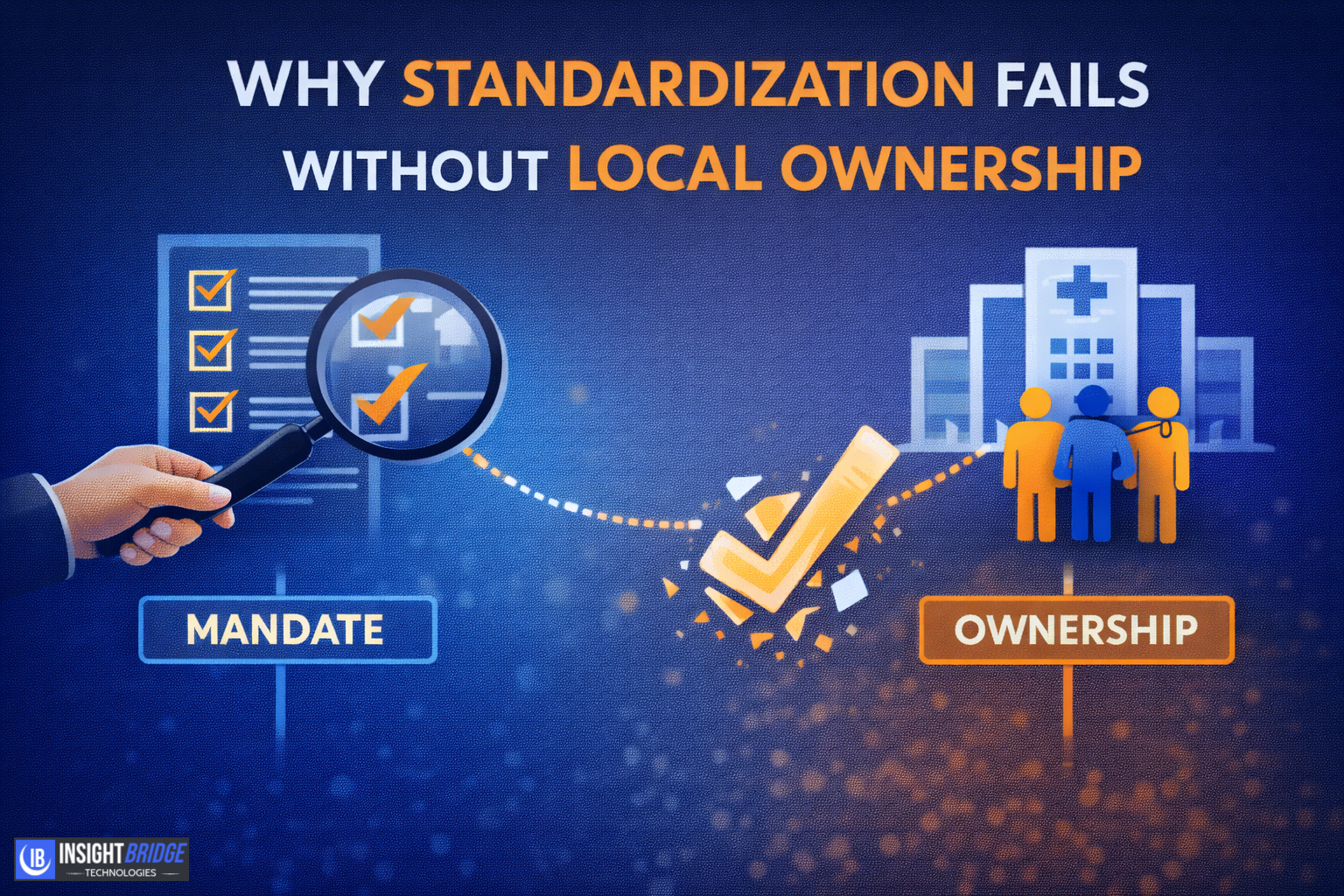
Why Standardization Fails Without Local Ownership
Standardization is a common goal in digital transformation.
Unified platforms.
Consistent workflows.
Shared data models.
On paper, it promises efficiency and scale.
In practice, standardization often fails—not because the standard is flawed, but because ownership is missing.
The Standardization Assumption
Enterprise leaders often assume that once a standard is defined, adoption will follow.
The logic seems sound:
- One system
- One workflow
- One way of working
But standardization imposed without ownership feels like compliance, not improvement.
And compliance rarely scales.
Where Standardization Breaks Down
Across healthcare and enterprise environments, the same patterns repeat.
Local context is ignored
Frontline teams understand their constraints better than central committees.
When standards don’t reflect operational reality, workarounds emerge immediately.
Accountability is unclear
Who owns the standard’s success locally?
When outcomes lag, responsibility diffuses upward instead of inward.
Exceptions become the norm
Without local ownership, exceptions multiply.
Over time, the “standard” becomes theoretical.
Trust erodes
Teams disengage when standards feel imposed rather than co-created.
Adoption becomes passive at best, resistant at worst.
Why Mandates Don’t Create Adoption
Standardization is not a policy problem.
No directive can:
- Create ownership
- Build trust
- Adapt to local realities
- Sustain behavioral change
Those emerge when people feel responsible for outcomes — not just compliance.
What Scalable Organizations Do Differently
Organizations that succeed with standardization anchor it locally.
They:
- Define what must be standardized — and what can remain flexible
- Assign clear local ownership for adoption and outcomes
- Involve frontline teams early in design and iteration
- Measure success by results, not adherence
Standards become shared tools, not imposed rules.
The InsightBridge Perspective
At InsightBridge, we see standardization succeed when leaders treat it as a partnership.
Enterprise direction provides clarity.
Local ownership provides durability.
Without both, standards fade the moment attention shifts.
Leadership Takeaway
Standardization doesn’t fail because people resist change.
It fails when no one owns the outcome.