
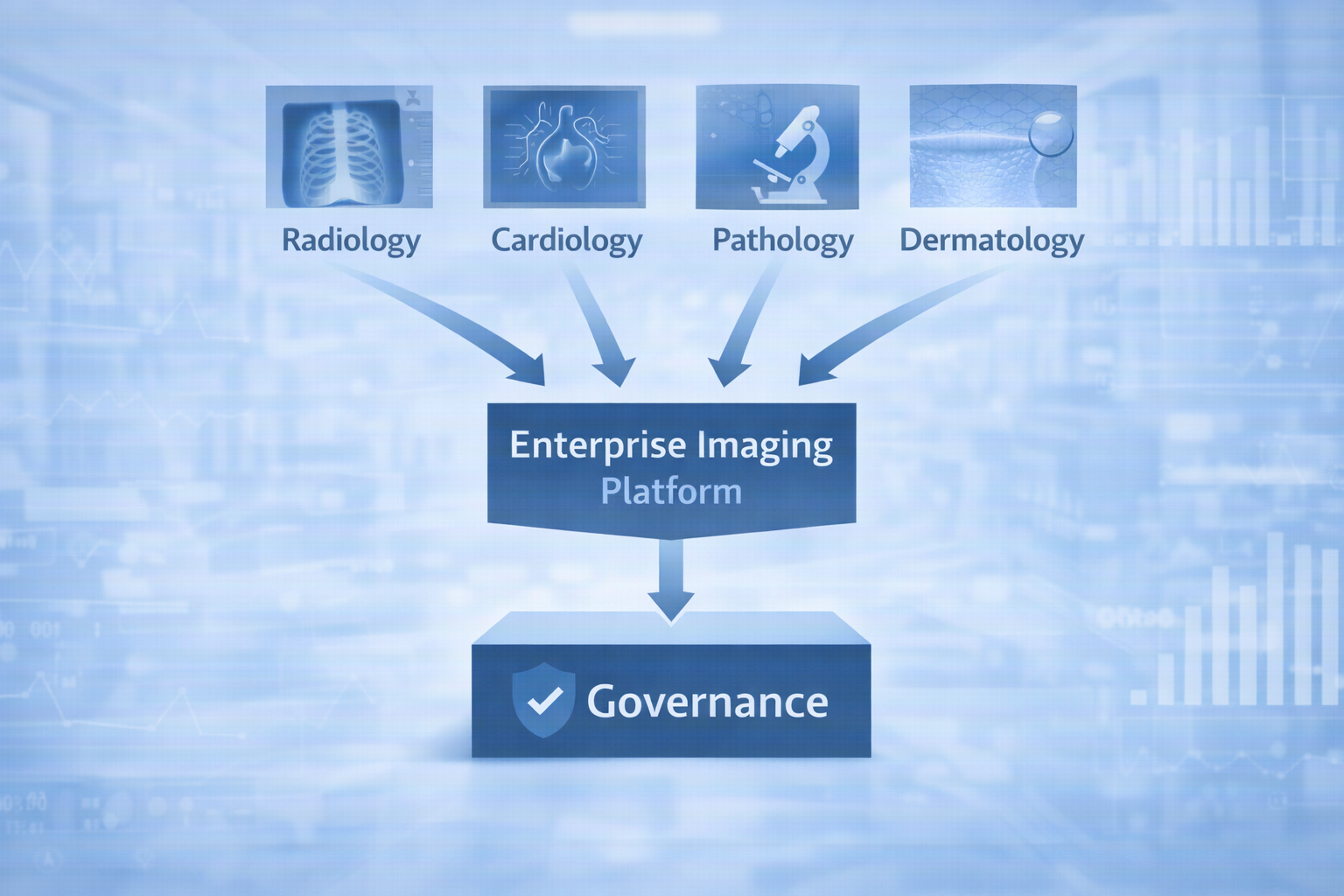
Enterprise imaging has become a strategic priority for many healthcare organizations.
Health systems pursue enterprise imaging initiatives to:
- Consolidate PACS environments
- Implement vendor-neutral archives
- Enable cross-specialty image access
- Support AI and advanced analytics
The technology is mature.
The strategy is often sound.
Yet many enterprise imaging programs struggle to deliver their full promise.
The issue is rarely the platform.
It is governance.
The Enterprise Imaging Misconception
Enterprise imaging is often treated as a technology consolidation effort.
A new archive is implemented.
Viewers are standardized.
Interfaces are built.
The assumption is that technology alignment will naturally produce enterprise alignment.
It rarely does.
Imaging ecosystems spans multiple specialties:
- Radiology
- Cardiology
- Pathology
- Dermatology
- Ophthalmology
- Point-of-care imaging
Each domain has its own workflows, priorities, and operational culture.
Without governance, enterprise imaging becomes a shared platform without shared standards.
Where Governance Gaps Appear
When governance is weak, predictable patterns emerge:
- Imaging standards vary across departments
- Metadata definitions diverge
- Storage policies conflict
- Workflow integration becomes inconsistent
- Viewer adoption fragments
The organization technically has an enterprise platform.
Operationally, it remains siloed.
Why Governance Matters More Than Technology
Enterprise imaging success depends on decisions that technology cannot enforce.
These include:
- Image ownership models
- Clinical workflow alignment
- Metadata and indexing standards
- Lifecycle management policies
- AI integration oversight
Without governance, each department adapts the system to its own needs.
Over time, enterprise consistency erodes.
What Successful Programs Do Differently
High-performing enterprise imaging programs treat governance as infrastructure.
They establish:
- Cross-specialty governance councils
- Clear imaging data ownership
- Enterprise metadata standards
- Lifecycle management frameworks
- Strategic oversight for AI-enabled imaging workflows
Technology becomes the platform.
Governance becomes the operating model.
The InsightBridge Perspective
We often see organizations invest heavily in enterprise imaging platforms while governance structures remain informal.
The result is predictable:
Enterprise technology.
Departmental behavior.
Sustained value emerges only when governance aligns clinical, operational, and technical priorities.
Leadership Takeaway
Enterprise imaging is not simply a technology architecture.
It is an enterprise operating model.
Organizations that recognize this early realize far greater value from their imaging investments.