

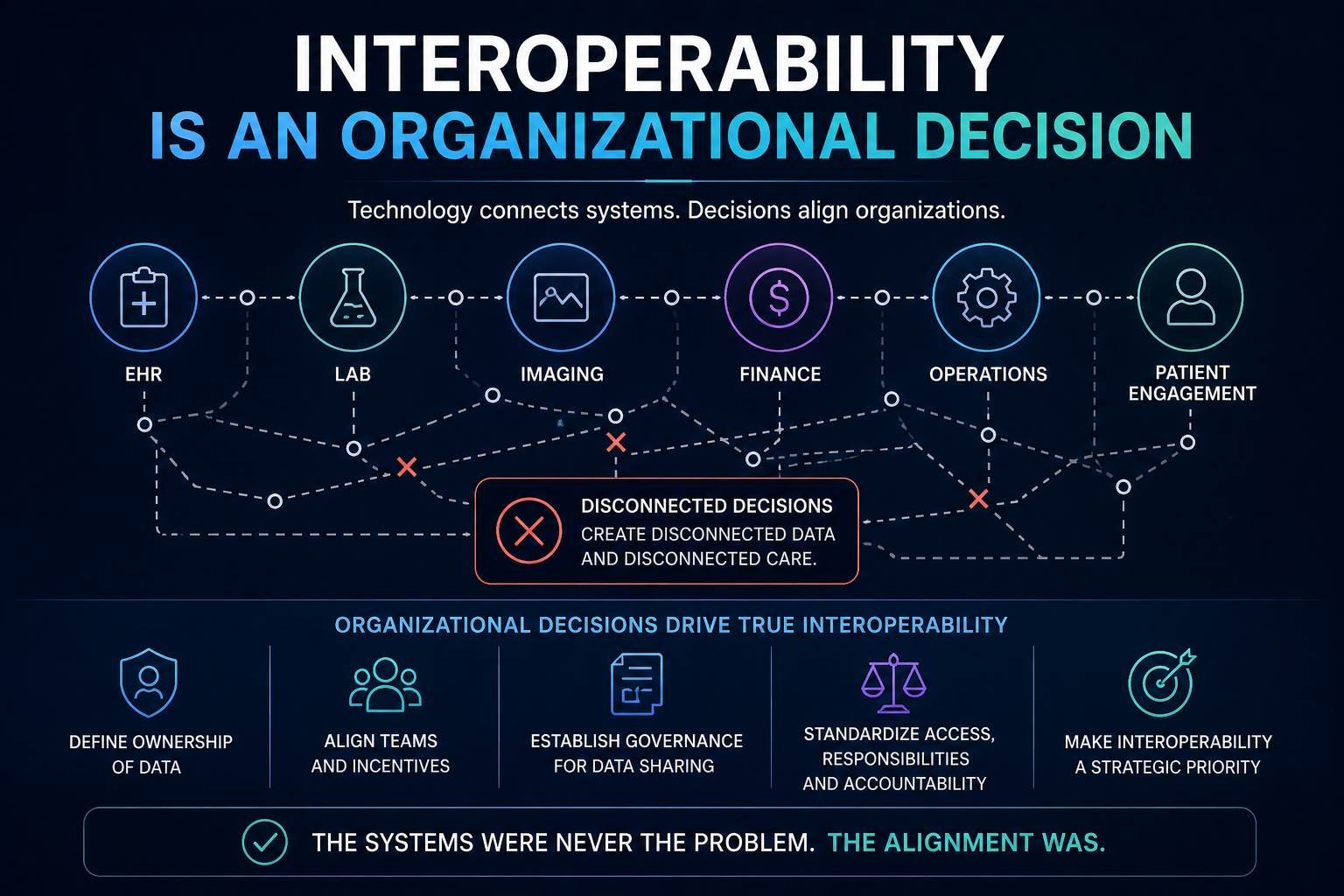
Interoperability is often framed as a technology challenge.
Organizations look for better integration engines, more flexible APIs, and new platforms to connect systems.
And while technology plays a role, it is rarely the limiting factor.
Because interoperability is not just about connecting systems.
It’s about aligning organizations.
Healthcare environments are filled with capable technologies.
Systems can exchange data.
Interfaces can be built.
Standards exist.
And yet, true interoperability remains difficult to achieve at scale.
Because the challenge is not simply technical.
It’s organizational.
Different departments operate with different priorities.
Ownership of data is often unclear.
Decisions about access, sharing, and integration are fragmented.
Governance structures are either missing or inconsistent.
In this environment, even the best technology cannot create meaningful interoperability.
Organizations that succeed take a different approach.
They treat interoperability as a strategic decision, not just a technical implementation.
They define data ownership across the enterprise.
They establish governance models that support data sharing.
They align incentives across clinical, operational, and IT teams.
They prioritize interoperability as a core component of their operating model.
In these environments, technology becomes an enabler — not a barrier.
The systems were never the problem.
The alignment was.
Interoperability isn’t achieved through tools alone.
It’s achieved through decisions about how the organization operates.