
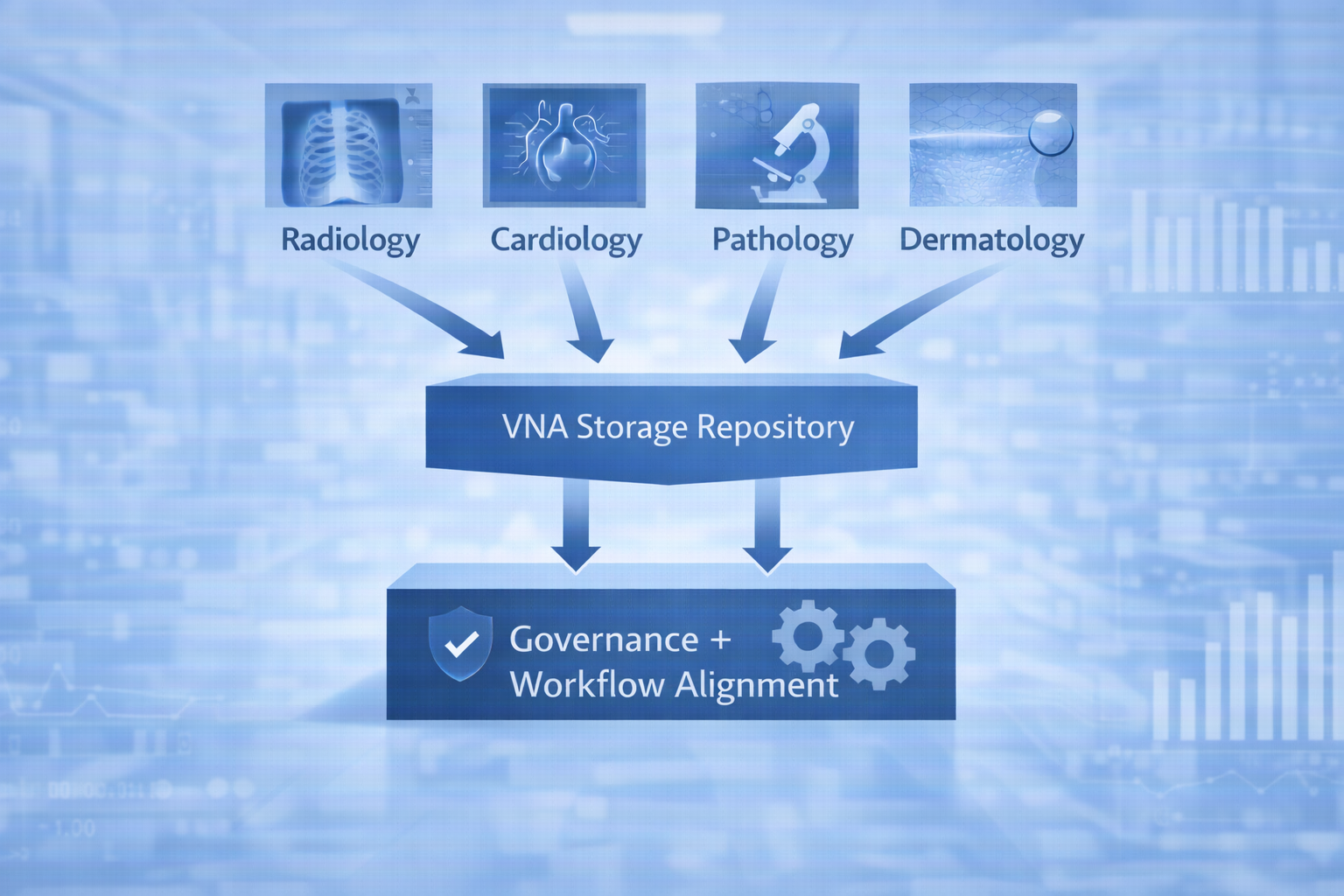
Why VNA Projects Fail to Deliver Enterprise Value
Vendor Neutral Archives (VNAs) have become a central component of many enterprise imaging strategies.
Health systems adopt VNAs to:
- Consolidate image storage across departments
- Reduce dependency on proprietary PACS archives
- Enable enterprise image accessibility
- Prepare for AI-driven imaging analytics
The technology itself is mature.
Yet many VNA initiatives struggle to deliver the enterprise value organizations expect.
The issue is rarely the archive platform.
It is the operating model surrounding it.
The VNA Misconception
VNA projects are often framed as storage consolidation efforts.
Images are migrated.
Legacy archives are retired.
A new enterprise repository is established.
These steps create technical centralization.
But centralization alone does not create enterprise value.
True enterprise imaging requires alignment across specialties, workflows, and governance structures.
Where VNA Programs Struggle
When governance and strategy are underdeveloped, common challenges appear:
- Departments continue managing imaging workflows independently
- Metadata standards remain inconsistent across specialties
- Image lifecycle policies vary between departments
- Enterprise viewers are implemented, but not universally adopted
- AI initiatives struggle due to inconsistent data structures
The archive becomes centralized.
The organization does not.
Why Storage Is Only the Beginning
A VNA can centralize image storage, but it cannot enforce:
- cross-specialty governance
- standardized imaging metadata
- enterprise workflow alignment
- shared clinical access policies
Those elements require organizational coordination.
Without them, the VNA becomes a large repository rather than a strategic enterprise platform.
What Successful VNA Programs Do Differently
Health systems that realize full value from VNA initiatives treat the archive as part of a broader enterprise imaging strategy.
They establish:
- enterprise imaging governance councils
- cross-specialty metadata standards
- consistent image lifecycle policies
- integrated clinical viewing strategies
- AI-ready imaging data frameworks
The archive becomes the foundation.
Governance and workflows unlock the value.
The InsightBridge Perspective
We frequently see healthcare organizations invest significantly in VNA technology while enterprise imaging governance remains informal.
Technology centralizes storage.
But without coordinated governance, departments continue operating independently.
Enterprise imaging value emerges only when clinical workflows, data standards, and governance structures evolve alongside the technology.
Leadership Takeaway
A VNA is not an enterprise imaging strategy.
It is infrastructure.
Organizations that treat VNA as part of a broader governance and workflow transformation realize far greater value from their imaging investments.