
Many organizations approach AI readiness as a technology initiative.
They evaluate vendors.
They identify use cases.
They launch pilots.
And only then do they begin asking whether the organization is actually prepared to support AI at scale.
But AI readiness starts long before implementation.
It begins with the underlying structure of the organization itself.
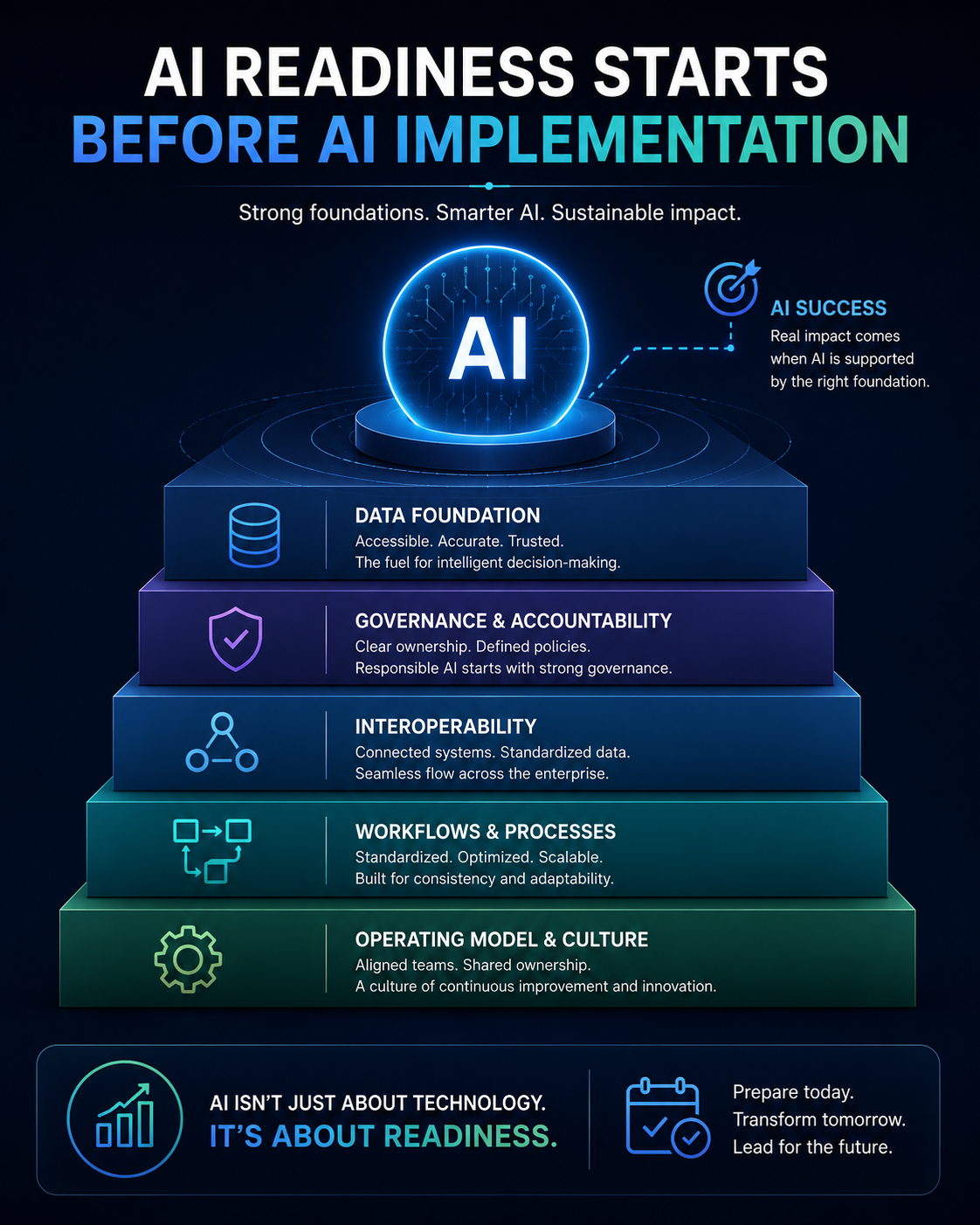
AI depends on accessible and trusted data.
It depends on standardized workflows.
It depends on governance models that define ownership and accountability.
And it depends on operating environments designed for scalability and interoperability.
Many legacy environments were never built with those requirements in mind.
Systems were implemented to solve isolated operational needs.
Departments evolved independently.
Data became fragmented across platforms and workflows.
Over time, organizations accumulated technology — but not necessarily alignment.
This is why many AI initiatives struggle to scale beyond pilot phases.
The challenge is rarely just the model.
It’s the environment surrounding it.
Organizations that successfully adopt AI recognize this early.
They invest in interoperability.
They modernize operating models.
They redesign workflows around accessibility and integration.
And they establish governance frameworks before AI becomes embedded into enterprise operations.
In these environments, AI is not forced onto legacy structures.
It is supported by systems intentionally designed to evolve with it.
AI readiness doesn’t begin when implementation starts.
It begins when organizations start redesigning how they operate.