
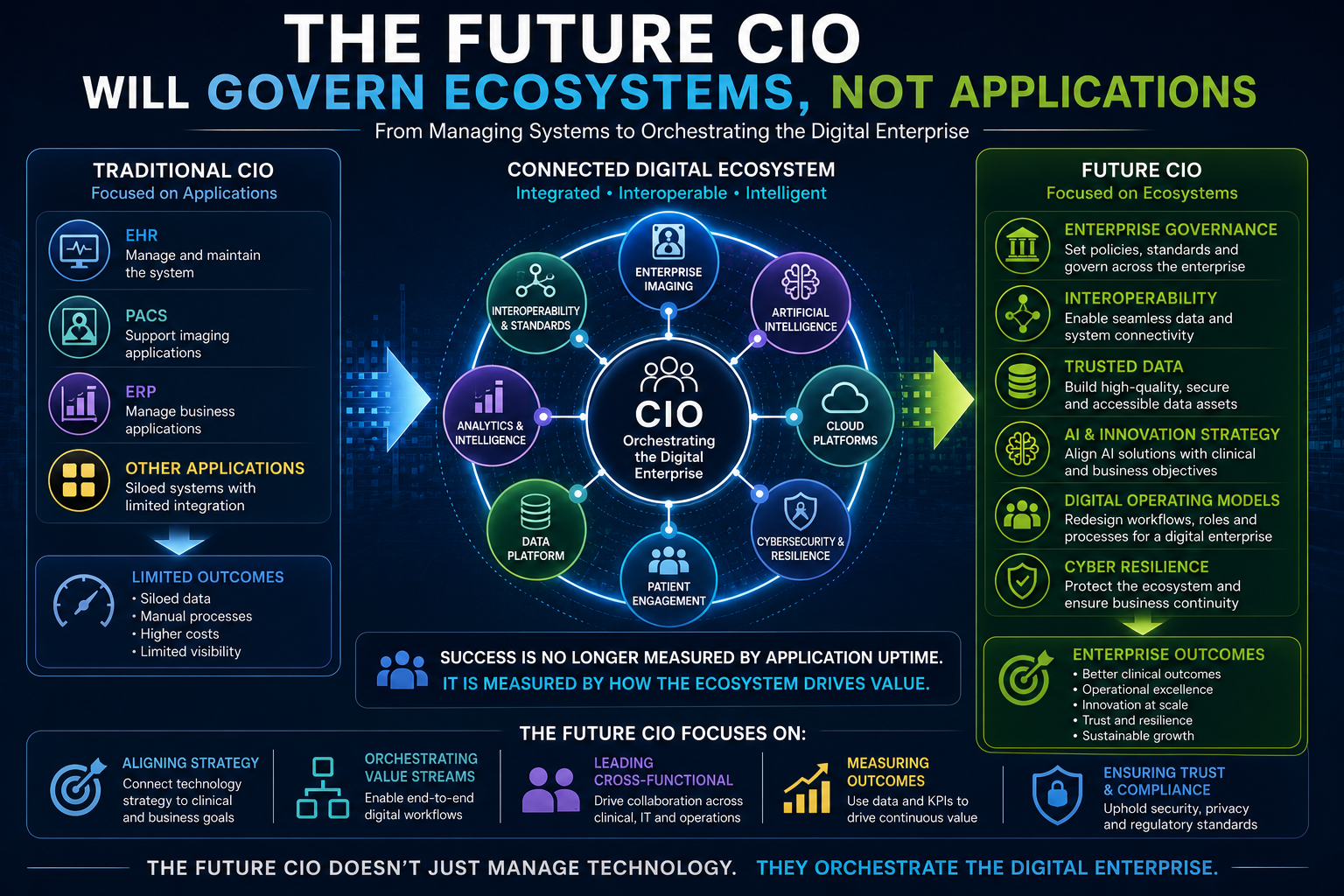
For decades, healthcare technology leadership centered on applications.
Implement the EHR.
Upgrade the PACS.
Deploy the ERP.
Support individual systems.
Success was often measured by uptime, project delivery, and application performance.
That model is rapidly changing.
Today’s healthcare organizations operate through interconnected digital ecosystems rather than isolated applications.
Enterprise imaging connects with the EHR.
Artificial intelligence relies on trusted data.
Cloud platforms enable scalability.
Analytics drive operational decisions.
Patient engagement spans multiple digital touchpoints.
No single application delivers enterprise value on its own.
The value comes from how these technologies work together.
As a result, the role of the CIO is evolving.
Tomorrow’s CIO will spend less time managing applications and more time governing ecosystems.
That includes:
- Establishing enterprise governance
- Defining interoperability strategies
- Building trusted data foundations
- Aligning AI with clinical and business objectives
- Creating scalable operating models
- Ensuring cybersecurity and resilience across the digital enterprise
Success will no longer be measured solely by whether applications are available.
It will be measured by whether the entire ecosystem enables better clinical outcomes, operational performance, and strategic growth.
Technology leadership is becoming ecosystem leadership.
Healthcare organizations that recognize this shift early will be better positioned to adapt, innovate, and scale in an increasingly connected future.
The future CIO will not simply manage technology.
They will orchestrate the digital enterprise.