

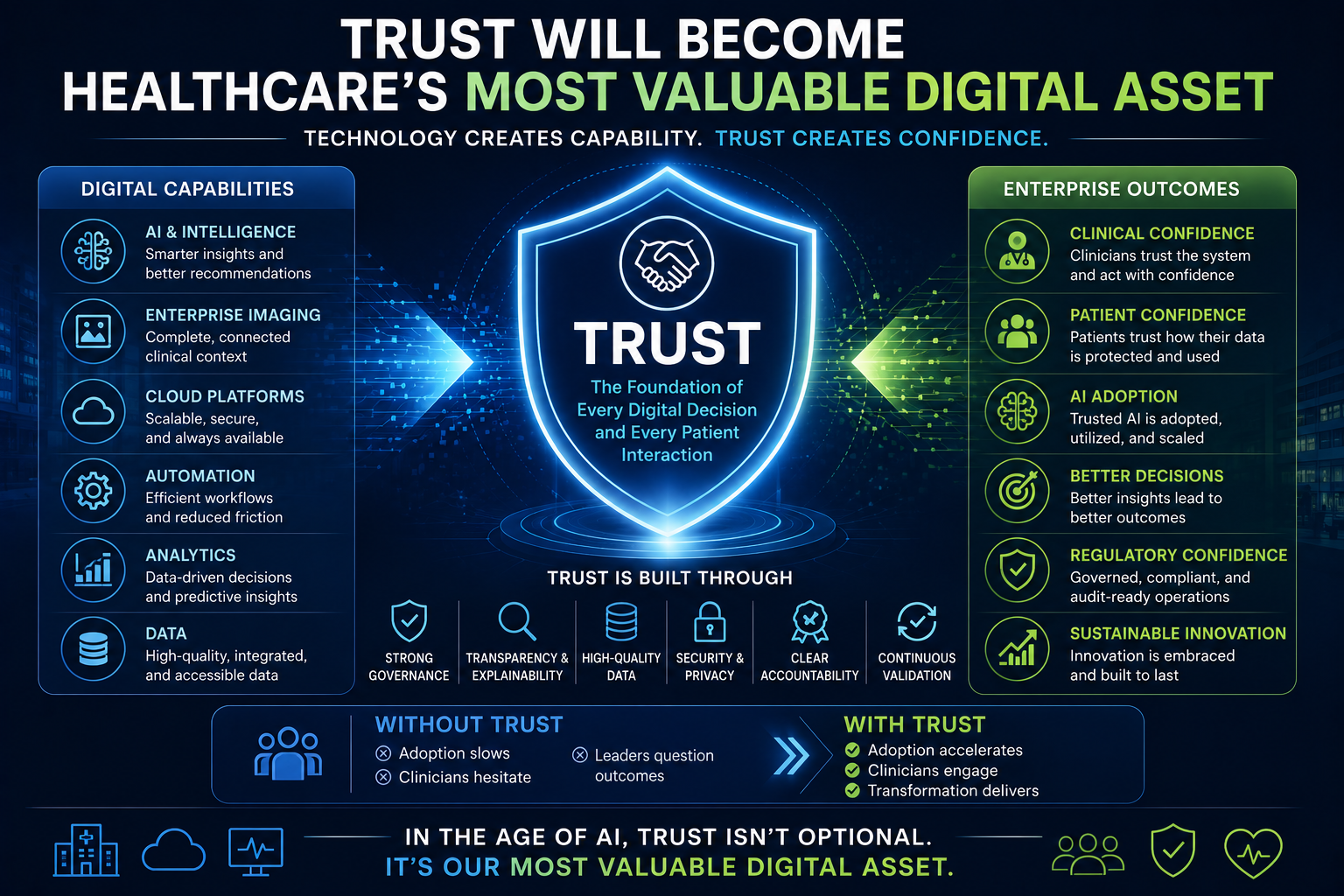
Healthcare organizations have spent the last decade investing in digital capabilities.
Electronic health records.
Enterprise imaging.
Cloud platforms.
Artificial intelligence.
Automation.
Analytics.
The next decade will be different.
Technology will no longer be the primary differentiator.
Trust will.
As AI becomes embedded in clinical and operational workflows, healthcare leaders face a new challenge.
Not whether technology can make better recommendations.
But whether people trust those recommendations enough to act on them.
Trust is rapidly becoming an enterprise capability.
Clinicians need confidence that AI recommendations are accurate, explainable, and aligned with clinical standards.
Executives need confidence that automated workflows remain governed, measurable, and accountable.
Patients need confidence that their information is protected and used responsibly.
Without trust, even the most advanced technologies struggle to achieve meaningful adoption.
Organizations hesitate.
Clinicians override recommendations.
Leaders question outcomes.
Transformation slows.
Organizations that succeed understand that trust is intentionally built.
It is created through strong governance, transparent decision-making, high-quality data, cybersecurity, continuous validation, and clear accountability.
Technology enables intelligent healthcare.
Trust enables organizations to use that intelligence with confidence.
The organizations that lead the next decade will not necessarily deploy the most AI.
They will build the most trusted digital ecosystems.
Because in healthcare, trust has always been essential.
In the age of AI, it may become the most valuable digital asset an organization owns.