
Healthcare organizations often think about vendor lock-in during contract negotiations.
Termination clauses.
Renewal terms.
Data extraction fees.
Pricing protections.
Those provisions matter.
But by the time vendor lock-in becomes a contract problem, it may already be too late.
The deeper issue is architecture.
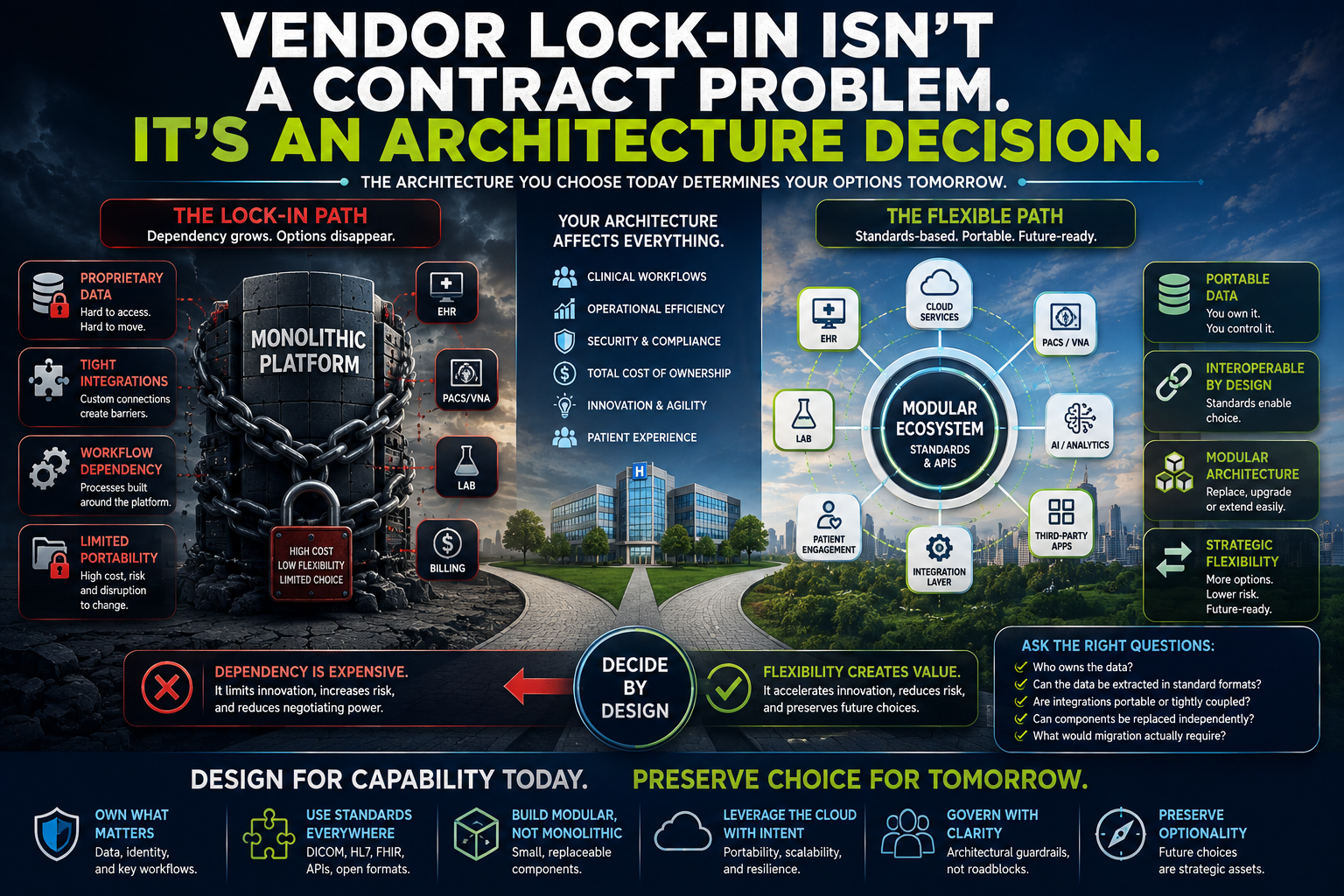
Organizations become dependent on vendors not simply because of contracts, but because technology becomes embedded across data, workflows, integrations, infrastructure, and operations.
A platform may begin as one application.
Over time, interfaces are built around it.
Workflows are redesigned for it.
Data accumulates inside it.
Teams develop specialized expertise around it.
Other applications become dependent on it.
Eventually, replacing the platform becomes significantly more difficult than replacing the contract.
This is especially important in healthcare environments where clinical systems, enterprise imaging, cloud platforms, AI, and interoperability services are increasingly interconnected.
Strategic technology decisions should therefore consider exit flexibility from the beginning.
Leaders should ask:
• Who owns the data?
• Can the data be extracted in usable, standards-based formats?
• How dependent are workflows on proprietary capabilities?
• Are integrations portable or tightly coupled?
• Can components be replaced independently?
• What would migration actually require?
• Does the architecture preserve future choices?
Vendor relationships are important.
Strong partnerships can accelerate innovation, reduce operational burden, and provide capabilities organizations could not efficiently build themselves.
The objective is not to avoid vendors.
It is to avoid unnecessary dependency.
Good architecture allows organizations to leverage vendor capabilities while maintaining control over the assets and decisions that matter most.
That includes data portability, interoperability, modularity, standards, governance, and clear ownership.
Technology decisions made today can either preserve or restrict tomorrow’s options.
A single contract rarely causes vendor lock-in.
It develops gradually through architectural decisions.
The strongest enterprise architectures don’t eliminate dependency.
They make dependency intentional, visible, and manageable.
Strategic flexibility should be designed in—not negotiated after the organization needs it.