

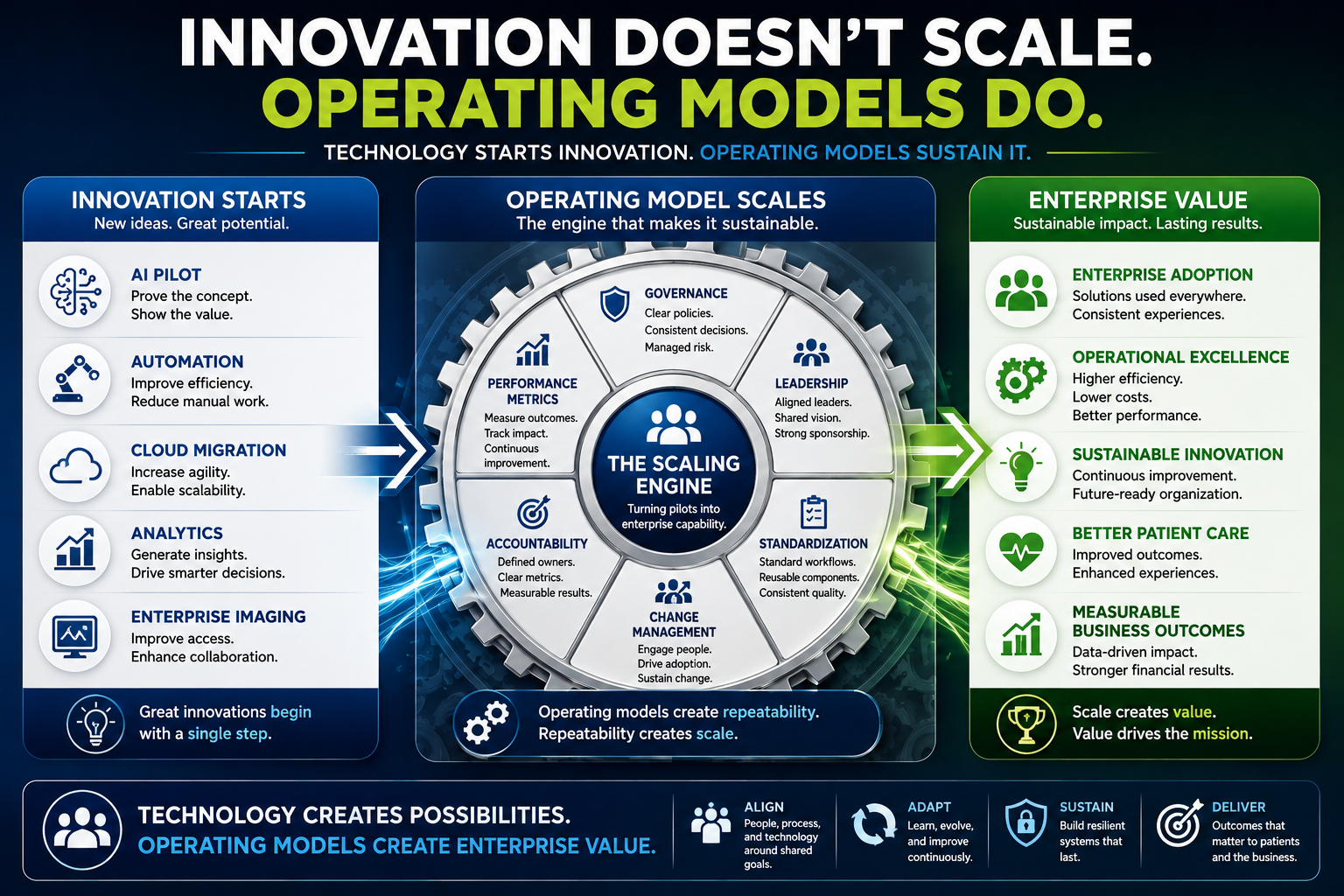
Healthcare organizations are investing more than ever in innovation.
Artificial intelligence.
Automation.
Cloud modernization.
Enterprise imaging.
Predictive analytics.
Digital patient engagement.
Many of these initiatives begin with successful pilots.
They demonstrate value.
Generate excitement.
Earn executive support.
Yet surprisingly few achieve enterprise-wide adoption.
The reason is rarely the technology itself.
It is the operating model.
Innovation introduces new possibilities.
Operating models determine whether those possibilities become sustainable capabilities.
Without clearly defined governance, standardized workflows, accountable leadership, measurable outcomes, and organizational alignment, even the most promising innovations struggle to scale.
Technology can automate a task.
It cannot redesign an organization.
Scaling innovation requires more than funding.
It requires repeatable processes.
Cross-functional collaboration.
Clear decision-making.
Change management.
Performance measurement.
Continuous improvement.
Healthcare organizations that consistently scale innovation treat every successful pilot as the beginning of transformation—not the end.
They invest as much in organizational readiness as they do in technology.
Innovation creates opportunity.
Operating models create enterprise value.
The organizations that lead the next decade of healthcare won’t necessarily be those with the newest technology.
They will be the ones that can operationalize innovation consistently across the enterprise.