When Healthcare Systems Disagree, Which One Do You Trust?
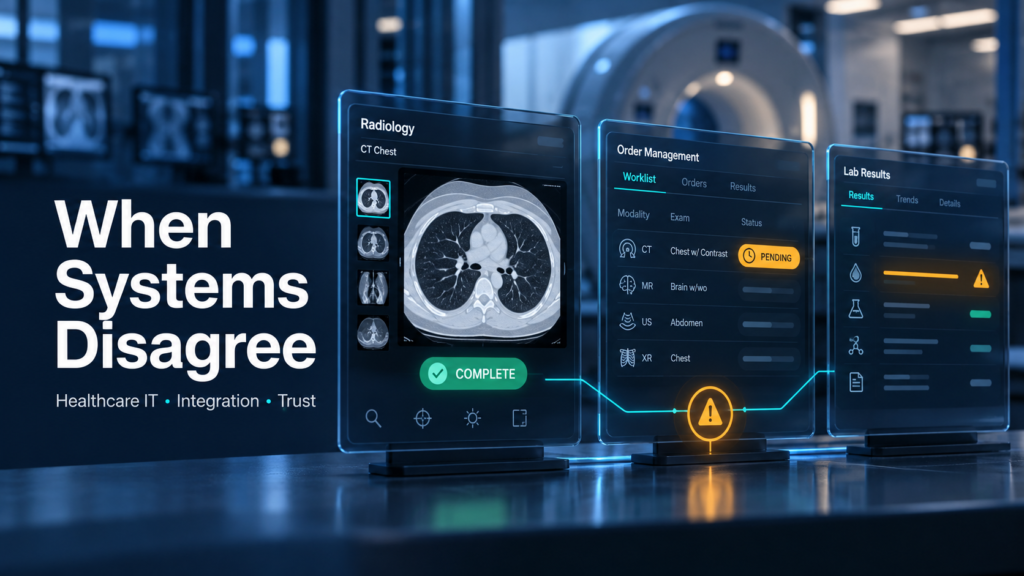
An imaging exam is marked complete in one application. Another worklist still shows it as pending. A report has been finalized, but a downstream screen displays an earlier version.
These are illustrative examples, but they raise a practical question for healthcare leaders: when connected systems disagree, how does the user know which information to trust?
In our previous article, we explored the work people carry between systems. Resolving conflicting information is another part of that work. A useful integration design makes the disagreement visible, assigns an owner, and gives the user a clear next action.
Define authority for each piece of information
“The source of truth” needs a more specific definition than the name of an application. An organization may designate one system to manage order details, another to record image availability, and another to manage report approval.
For each important data element or workflow state, document who can create it, who can change it, and how other systems receive the change. Include corrections, cancellations, and amended reports—not only the original transaction.
The most recently updated screen is not automatically the authoritative one. A local timestamp may reflect receipt or display refresh rather than the time the underlying clinical or operational event occurred.
Agree on what a status means
Two systems can use the same word for different milestones. “Complete” might refer to acquisition, interpretation, report approval, or another locally defined step.
Before connecting those states, ask clinical, operational, and technical owners to describe the event each status represents. Record the conditions required to enter that state and what should happen next.
This shared definition helps prevent an interface from carrying a technically valid update that users interpret differently.
Distinguish waiting from failure
A downstream application may be waiting for an expected update. An interface may have rejected a message. A transaction may have reached its destination without producing the intended workflow result.
Those situations need different responses. Where practical, show the last confirmed event, its source, and when it was received. Make delayed or unresolved states visible instead of presenting uncertain information as current.
Define acceptable delays with workflow owners. Time-sensitive clinical concerns should follow established patient-safety and escalation procedures; users should not have to infer a safe response from a technical status alone.
Give reconciliation an owner
An exception queue is useful only when someone is responsible for acting on it. Define who investigates, who can authorize a correction, and who confirms that the affected workflow is consistent again.
Users also need a clear route to report a discrepancy without creating competing records or repeatedly submitting the same action. Corrections and retries should preserve an audit trail and avoid duplicating completed work.
Escalation should connect technical investigation with the people responsible for the operational consequence.
Test disagreements deliberately
A successful transaction is only one test case. Include delayed updates, duplicate messages, out-of-order events, canceled orders, amended reports, and recovery after a connected service returns.
For each scenario, check what the user sees, who receives the exception, and how the systems return to an agreed state. Confirm the affected workflow with its users as well as reviewing technical logs.
A focused custom application can help surface exceptions or coordinate reconciliation, provided it has clear authority boundaries and an operational owner.
Give AI reliable context
AI assistance needs the same discipline. Define which source and version may be used, how missing or conflicting information is identified, and when the workflow requires human review before proceeding.
Do not assume generated text resolves a disagreement between underlying records. Preserve the source information and make proposed changes reviewable.
Our IB AI Reporting prototype remains in development and testing. Editable reports and clinician review remain central considerations as we explore how AI assistance fits into reporting workflows.
Build trust into the handoff
At InsightBridge Technologies, we approach these questions through healthcare IT experience, integration planning, custom software development, and AI exploration.
The goal is a workflow in which people can understand where information came from, what it means, and what to do when it conflicts.
If two systems disagree today, can your team name the authoritative source, the reconciliation owner, and the next action?