
When organizations struggle with transformation, the first instinct is often to look at technology.
Was the platform implemented correctly?
Are the tools sufficient?
Do we need a better solution?
Rarely is governance questioned first.
Yet governance is often the deciding factor between progress and stagnation.
The Governance Misconception
Governance is frequently perceived as:
- Oversight
- compliance
- approval structures
- administrative process
As a result, it is often minimized or delayed.
Organizations prioritize execution and assume governance will follow.
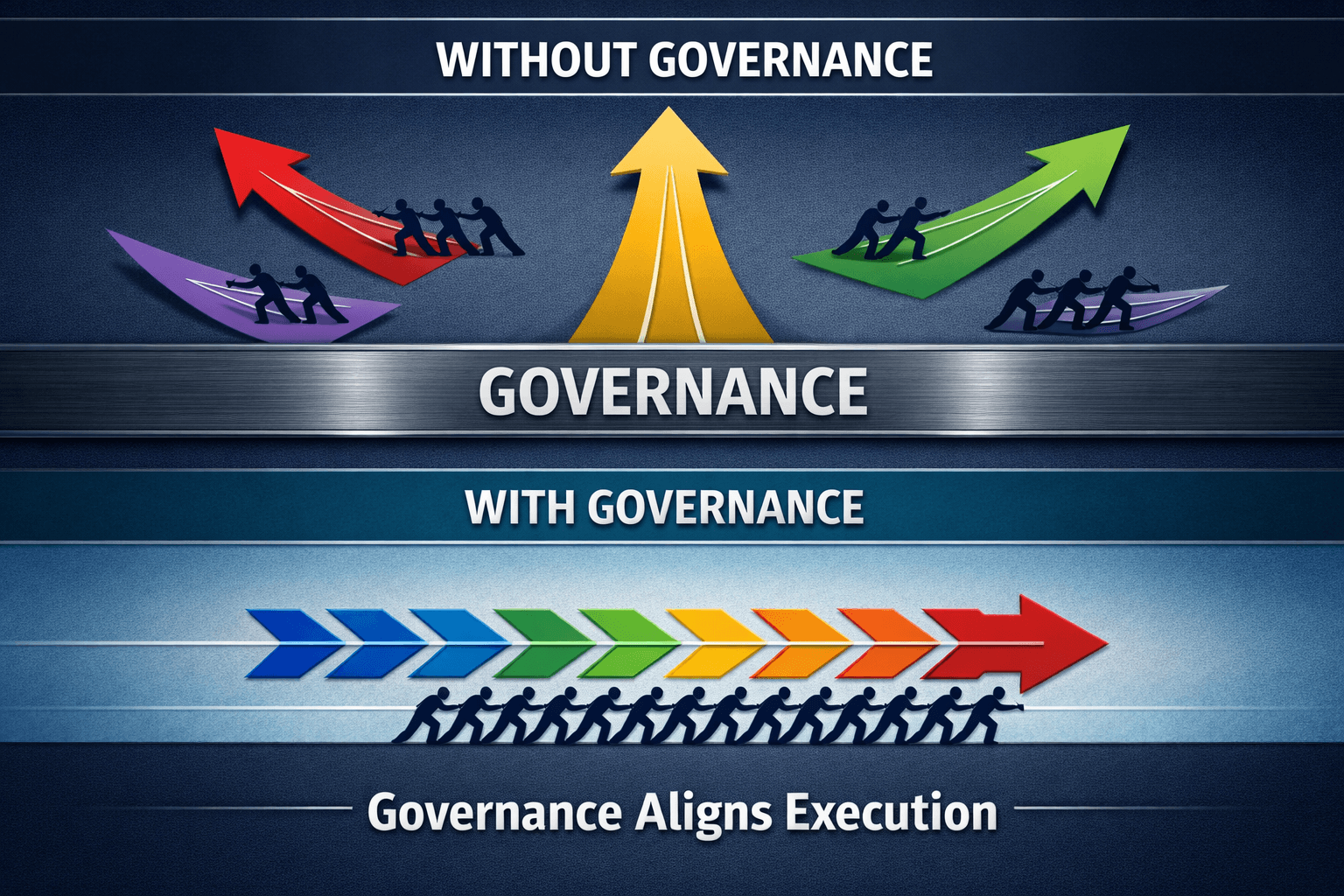
In reality, governance defines how transformation operates.
What Governance Actually Does
Effective governance establishes:
- decision rights
- accountability
- Prioritization frameworks
- Escalation paths
- Alignment between business and technology
It answers critical questions:
- Who decides?
- What takes priority?
- How are conflicts resolved?
- How is success defined?
Without clear answers, execution becomes inconsistent.
Where Transformation Breaks Down
When governance is weak or unclear:
- Priorities shift without coordination
- Teams operate with different assumptions
- Exceptions become the norm
- Decision-making slows, or fragments
- Accountability becomes diffuse
The organization continues to work.
But alignment deteriorates.
Why Governance Is Often Underestimated
Governance is not as visible as technology.
There is no system to launch.
No interface to demonstrate.
No immediate milestone to celebrate.
Its impact is structural.
And structural elements are often overlooked until problems emerge.
What Strong Organizations Do Differently
Organizations that succeed in transformation:
- define governance early — not after deployment
- Align governance with clinical and operational workflows
- establish clear ownership across domains
- enforce consistency while allowing controlled flexibility
- treat governance as an operational capability
They understand that governance is not a constraint.
It is an enabler of scale.
The InsightBridge Perspective
Across transformation initiatives, we consistently observe:
Technology enables change.
Governance determines whether that change sustains.
Organizations that invest in governance early move faster over time.
Those who delay it experience friction later.
Leadership Takeaway
Governance is not an administrative layer.
It is the operating system of transformation.
Organizations that recognize this shift build momentum that is both faster and more sustainable.