

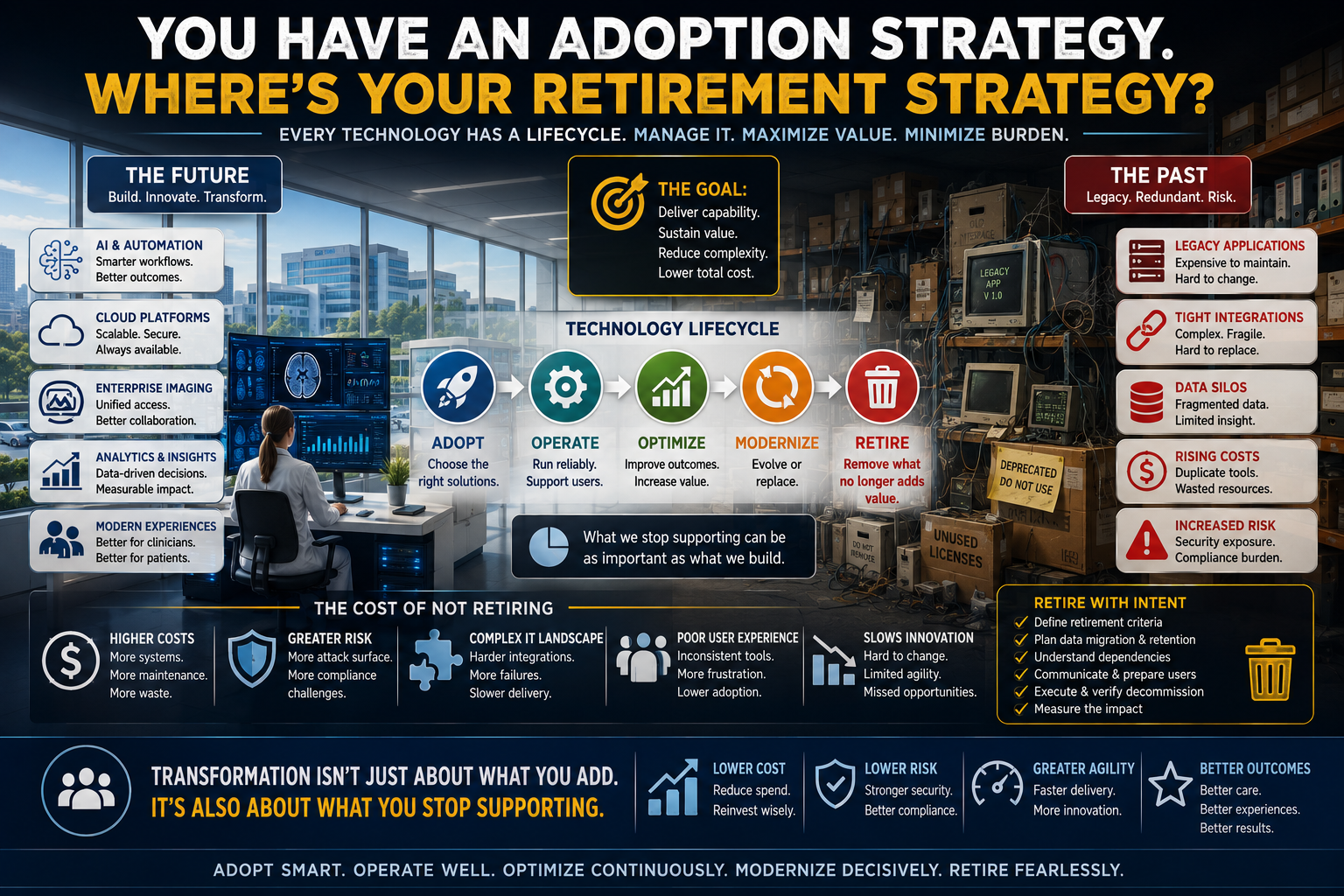
Healthcare organizations are very good at adding technology.
New applications.
New AI tools.
New imaging platforms.
New cloud services.
New analytics capabilities.
New integrations.
Every investment usually begins with a business case, implementation plan, governance process, and go-live strategy.
But there is another question organizations ask far less often:
What are we going to retire?
Over time, technology portfolios expand.
Legacy applications remain because one department still uses them.
Old interfaces continue running because replacing them feels risky.
Duplicate platforms survive mergers and acquisitions.
Temporary workflows become permanent.
Data remains distributed across systems that were supposed to be decommissioned years ago.
Eventually, organizations are supporting both the future and the past.
The consequences are significant.
Costs increase.
Cybersecurity exposure expands.
Integration complexity grows.
Data becomes fragmented.
Support teams are stretched across more platforms.
Users face inconsistent experiences.
And innovation becomes harder because every new capability must coexist with years of accumulated technology.
This is why technology lifecycle management should be an enterprise discipline—not an occasional cleanup exercise.
Every significant technology investment should have a lifecycle strategy that addresses:
• Business value
• Adoption and utilization
• Total cost of ownership
• Security and compliance risk
• Integration dependencies
• Data retention and migration
• Vendor viability
• Replacement criteria
• Retirement triggers
The objective is not to eliminate older technology simply because it is old.
Some mature platforms continue delivering tremendous value.
The objective is to continuously determine whether each capability still earns its place in the enterprise architecture.
That requires governance.
Leaders should know which platforms are strategic, which are transitional, which are redundant, and which should be retired.
And retirement should be planned as deliberately as implementation.
Data must be preserved appropriately.
Dependencies must be understood.
Workflows must transition safely.
Users must be prepared.
Contracts and infrastructure must actually be terminated.
Digital transformation cannot consist solely of adding the new.
Sometimes transformation requires removing what no longer creates value.
Organizations that manage technology as a lifecycle—not a collection of permanent investments—reduce complexity, improve resilience, lower cost, and create more room for innovation.
A mature technology strategy answers two questions equally well:
What should we introduce next?
And:
What should we stop supporting?