
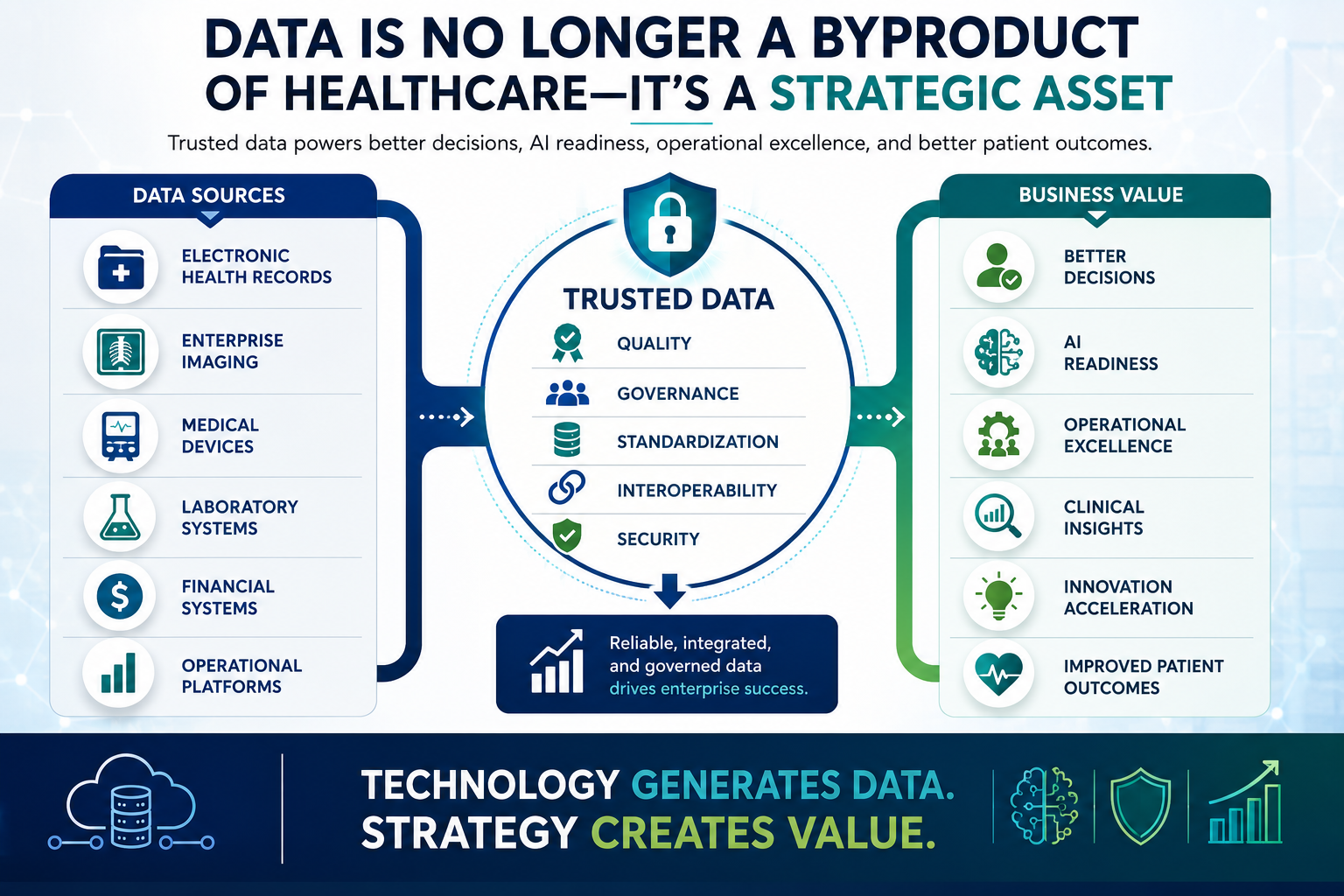
Every healthcare organization generates enormous amounts of data.
Clinical documentation.
Medical imaging.
Laboratory results.
Device data.
Operational metrics.
Financial information.
Historically, much of this data was viewed as a byproduct of care delivery—a record of what had already happened.
Today, that perspective is changing.
Data has become one of healthcare’s most valuable strategic assets.
Artificial intelligence depends on trusted data.
Operational analytics depend on high-quality data.
Clinical decision support relies on timely and accurate information.
Population health initiatives require integrated datasets.
Executive decisions are only as strong as the information that supports them.
The challenge is not the volume of data.
The challenge is turning that data into trusted, actionable intelligence.
Organizations that succeed invest in more than storage and reporting.
They build enterprise data strategies.
They establish governance.
They improve data quality.
They standardize definitions.
They reduce duplication.
They strengthen interoperability.
Most importantly, they create confidence that data can be used to support critical clinical and business decisions.
Technology creates data.
Strategy creates value.
Healthcare organizations that treat data as a strategic asset will be better positioned to adopt AI, improve operational performance, accelerate innovation, and deliver better patient outcomes.
The future of healthcare will not be defined by who has the most data.
It will be defined by who can trust it, govern it, and use it to make better decisions.