

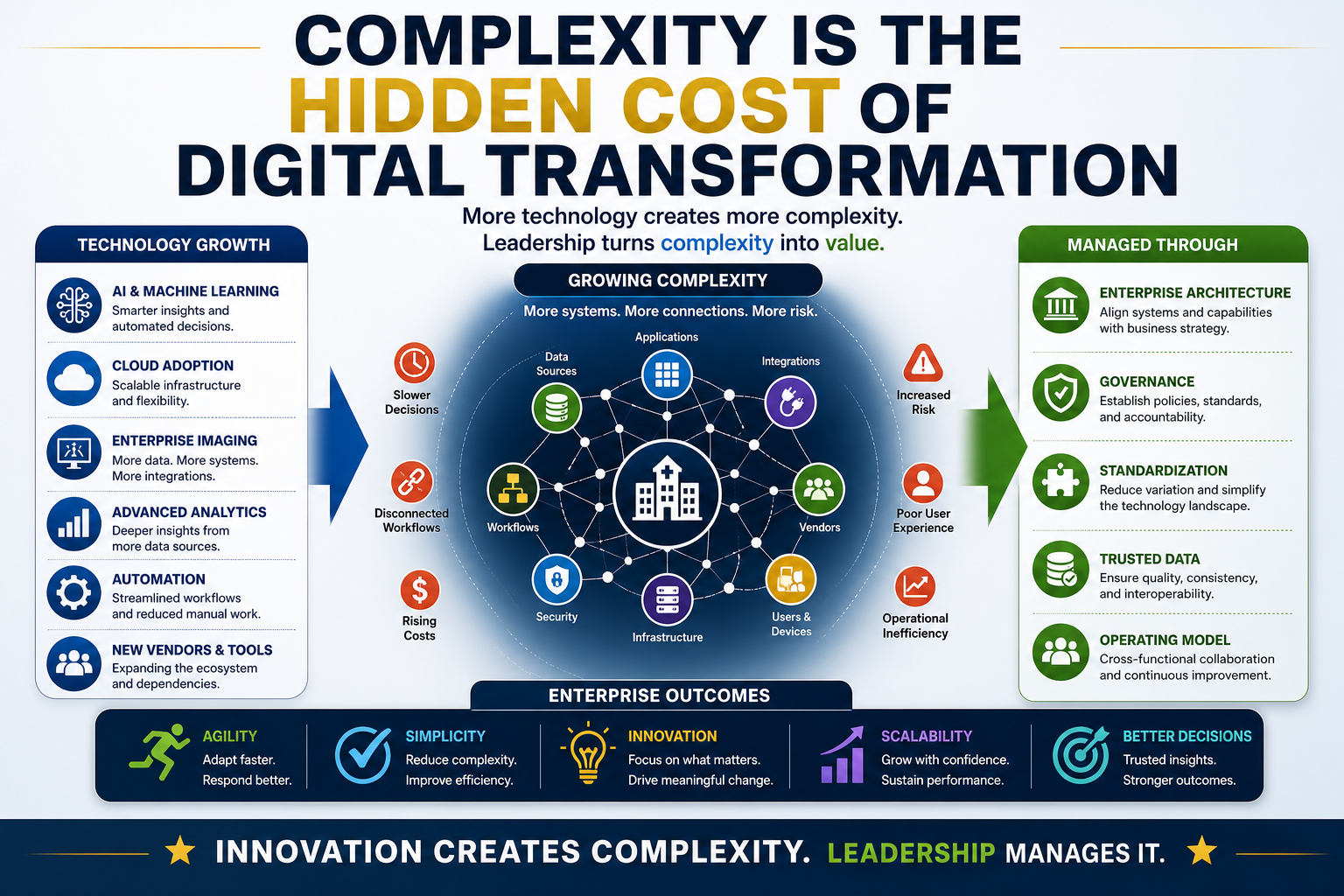
Digital transformation is often associated with innovation.
New AI capabilities.
Cloud adoption.
Enterprise imaging.
Advanced analytics.
Automation.
Each initiative promises measurable improvements.
But every new capability also introduces something less visible.
Complexity.
Healthcare organizations rarely struggle because they lack technology.
More often, they struggle because technology has evolved faster than the organization’s ability to manage it.
Every new application creates another integration.
Every new workflow introduces another dependency.
Every new vendor expands the technology ecosystem.
Every new data source increases governance requirements.
Complexity grows quietly.
Until it begins affecting operations.
Organizations experience slower decision-making.
Disconnected workflows.
Rising support costs.
Conflicting priorities.
Inconsistent user experiences.
Technology isn’t the problem.
Unmanaged complexity is.
Successful digital transformation isn’t about implementing the most technology.
It’s about creating an enterprise that remains simple enough to operate, scalable enough to grow, and flexible enough to adapt.
That requires intentional architecture.
Strong governance.
Standardized operating models.
Trusted data.
Cross-functional collaboration.
Organizations that treat complexity as a strategic risk are better positioned to innovate without sacrificing agility.
Digital transformation creates opportunity.
Managing complexity determines whether that opportunity becomes sustainable value.