Technical Debt Is No Longer an IT Problem—It’s a Business Risk
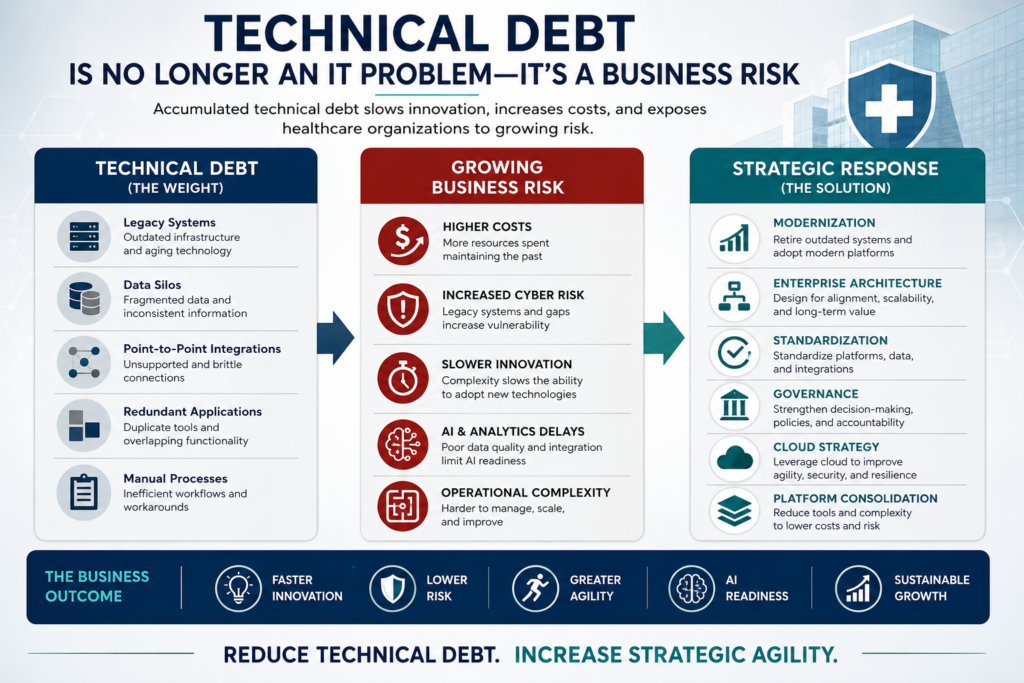
Healthcare organizations are under constant pressure to innovate.
Artificial intelligence.
Digital transformation.
Cloud migration.
Enterprise imaging.
Automation.
Advanced analytics.
Yet many organizations struggle to move forward as quickly as they would like.
The obstacle is often not a lack of vision.
It’s accumulated technical debt.
Technical debt isn’t simply outdated hardware or aging software.
It includes fragmented applications, unsupported integrations, inconsistent data, redundant workflows, legacy infrastructure, and years of tactical decisions made to solve immediate problems.
Over time, those decisions accumulate.
Innovation slows.
Support costs increase.
Cybersecurity risks expand.
Complexity grows.
The organization spends more time maintaining the past than building the future.
This is why technical debt is no longer just an IT concern.
It directly affects business agility, operational efficiency, financial performance, and the organization’s ability to adopt emerging technologies such as AI.
Organizations that treat technical debt as a strategic business issue make better long-term decisions.
They modernize intentionally.
They simplify where possible.
They standardize platforms.
They strengthen governance.
They align technology investments with enterprise priorities rather than short-term fixes.
Every organization carries some level of technical debt.
The difference lies in how actively it is managed.
Technology evolves continuously.
Organizations that invest in reducing technical debt create the flexibility needed to innovate, adapt, and scale with confidence.
Managing technical debt is not simply about replacing old technology.
It is about creating the foundation for the healthcare organization of tomorrow.