
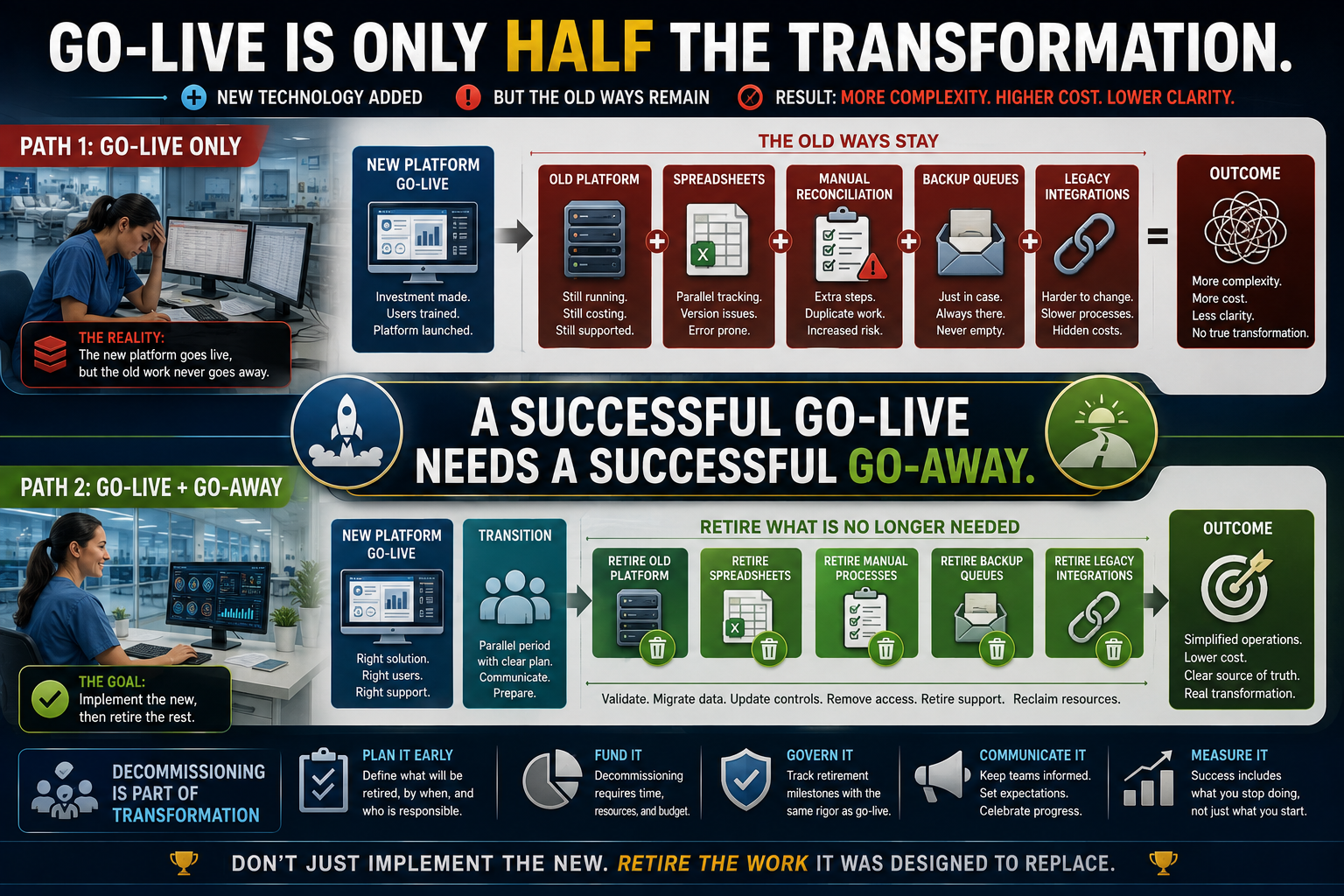
Healthcare technology programs invest enormous effort preparing for go-live.
Implementation teams are assembled.
Workflows are designed.
Interfaces are built.
Users are trained.
Testing is completed.
Support models are established.
Then the new platform launches.
But there is another milestone that receives far less attention:
Go-away.
What happens to the technology, workflows, integrations, spreadsheets, manual processes, and controls the new solution was supposed to replace?
Too often, they remain.
The new platform goes live, but the old spreadsheet continues.
Automation is introduced, but manual reconciliation remains “just in case.”
A new workflow launches, but the backup queue never disappears.
A replacement application has been implemented, but legacy interfaces continue to run.
What was intended to be temporary becomes permanent.
The result isn’t transformation.
It is accumulation.
More systems.
More workflows.
More controls.
More reconciliation.
More ambiguity about the source of truth.
And ultimately, more complexity.
This happens because organizations frequently treat decommissioning as a technical task at the end of implementation rather than as a defined workstream within the transformation itself.
True retirement requires more than shutting down a server or terminating a software license.
Organizations must determine what else can be retired with the platform:
• Manual workflows
• Parallel spreadsheets
• Redundant controls
• Legacy integrations
• Duplicate data stores
• Reconciliation processes
• Support procedures
• Operational ownership structures
Each needs an owner, retirement criteria, dependencies, validation, and a target date.
There may be legitimate reasons to maintain temporary parallel processes during transition.
But temporary needs an expiration condition.
Otherwise, the organization adds the new operating model on top of the old one.
That increases cost and operational burden while reducing clarity.
Transformation should simplify the organization—not create additional layers of work.
This is why decommissioning should be funded, governed, and measured as part of implementation from the beginning.
A technology business case should identify not only what the organization will gain, but what it expects to stop doing.
A project plan should include not only the go-live date but also the subsequent retirement milestones.
And success metrics should include not only adoption of the new capability but also the elimination of the unnecessary processes and technology it replaced.
Go-live proves the new capability works.
Go-away proves the organization actually transformed.
A successful go-live needs a successful go-away.