

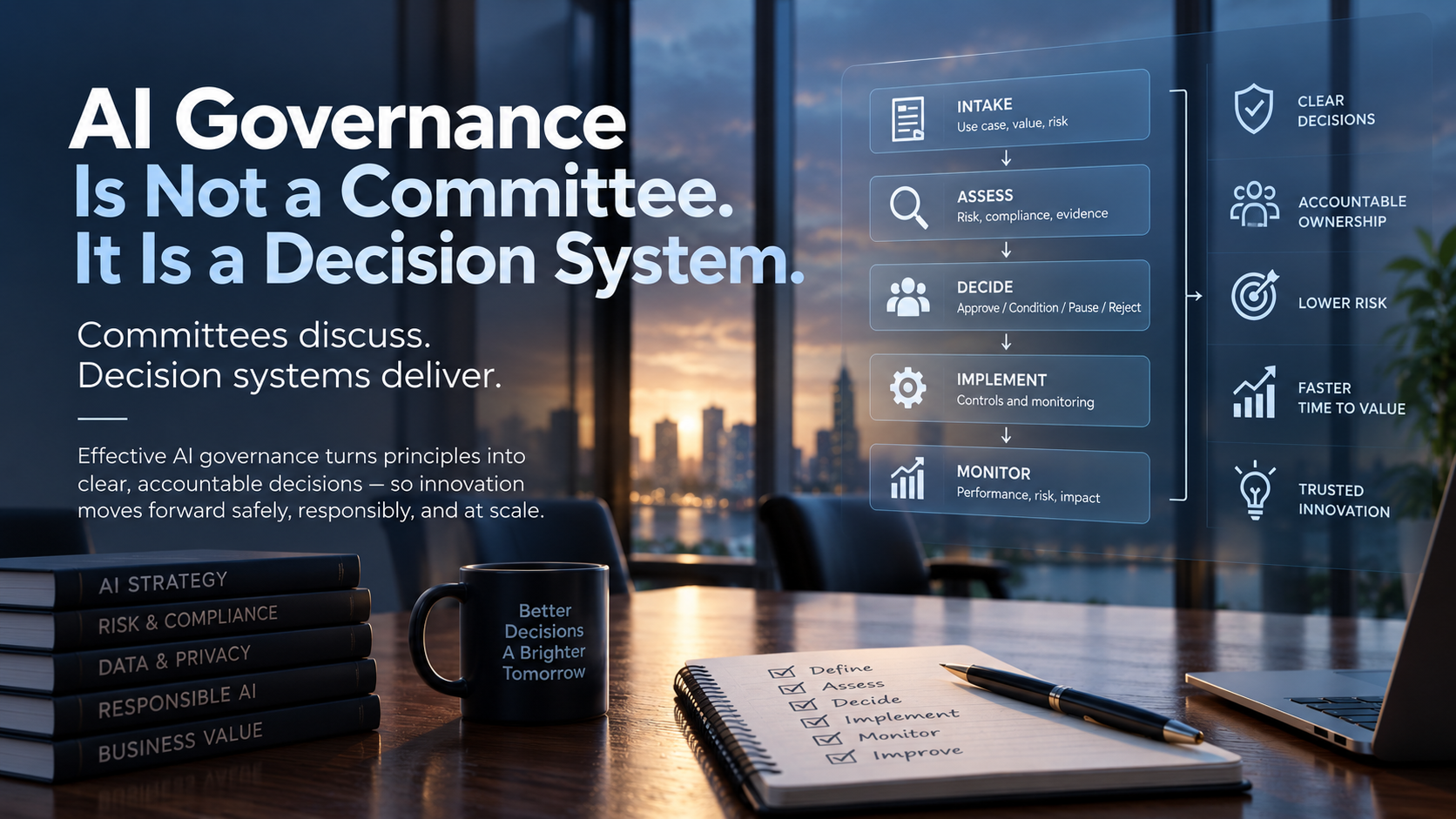
As healthcare organizations formalize AI governance, one of the first responses is often to create a committee.
Bring together clinical leadership, IT, security, compliance, legal, data, and operations. Establish recurring meetings. Review proposed AI solutions. Discuss risk.
That is an important start.
But a committee is not a governance model.
Governance exists to make decisions—and ensure those decisions remain accountable over time.
The Problem With Committee-Based Governance
Committees can bring the right people into the room while still leaving fundamental questions unanswered.
Who has authority to approve an AI capability?
What evidence is required before approval?
Which use cases require clinical validation?
When does a security concern become a reason to stop deployment?
Who owns the solution after implementation?
What happens when model performance changes?
And who has the authority to pause or retire it?
If those questions are answered differently every time a proposal reaches the committee, the organization has a meeting process—not a decision system.
Start With a Structured Intake
Good governance begins before the governance meeting.
Every proposed AI capability should enter through a consistent intake process that establishes the problem being solved, intended users, expected value, affected workflows, data requirements, technical dependencies, vendor involvement, and potential risk.
The objective is not bureaucracy.
It is ensuring that decision-makers evaluate comparable information rather than starting from scratch with every proposal.
Apply Governance Proportional to Risk
Not every AI capability deserves the same governance pathway.
An administrative productivity tool and an algorithm influencing a clinical diagnosis should not face identical review requirements.
Organizations need a risk-tiering model that determines the level of scrutiny based on factors such as:
- Clinical impact
- Patient safety
- Data sensitivity
- Level of autonomy
- Regulatory exposure
- Explainability
- Workflow dependency
- Consequences of incorrect output
Higher-risk capabilities should require stronger evidence, validation, controls, and monitoring.
Lower-risk capabilities should move through governance efficiently.
Good governance should increase control where risk is high without creating unnecessary friction everywhere else.
Define Decision Rights
This is where many governance models become ambiguous.
Participation is not the same as accountability.
Clinical leaders may assess clinical appropriateness. Security may evaluate cyber risk. Privacy and compliance may evaluate data use. Technology teams may assess architecture and integration. Finance may validate economics.
But the operating model must still establish:
Who recommends?
Who approves?
Who can impose conditions?
Who can escalate?
Who can pause deployment?
Who can retire the capability?
Without explicit decision rights, governance can become consensus-seeking rather than decision-making.
And consensus does not always produce accountability.
Governance Does Not End at Approval
AI governance becomes particularly important after deployment.
Models change.
Vendors release updates.
Data changes.
Clinical workflows evolve.
Users develop workarounds.
Performance can drift.
A capability that was appropriate when approved may not remain appropriate indefinitely.
That means the decision system must continue after go-live through defined monitoring of performance, adoption, risk, exceptions, overrides, outcomes, and material vendor or model changes.
The organization also needs thresholds that trigger reassessment.
Every AI Capability Needs an Owner
Someone must remain accountable for the capability throughout its lifecycle.
Not merely the infrastructure.
Not merely the vendor relationship.
The outcome.
That owner should understand why the capability exists, what success looks like, which risks are being managed, how performance is measured, and when continued investment should be questioned.
Without ownership, AI can become another permanent technology layer long after its original value proposition has changed.
The Goal Is Better Decisions, Not More Governance
Healthcare organizations do not need governance because AI is fashionable.
They need governance because AI introduces decisions involving clinical care, data, technology, risk, workflow, economics, and trust.
The purpose should therefore not be to create more meetings.
It should be to create a repeatable system that helps the organization answer:
Should we do this?
Under what conditions?
Who is accountable?
How will we know it is working?
What would cause us to stop?
When those questions can be answered consistently, governance becomes an accelerator rather than an obstacle.
A committee can discuss AI.
A decision system governs it.
At InsightBridge Technologies, we help healthcare organizations connect AI strategy, governance, enterprise architecture, and operational accountability so innovation can move from experimentation to sustainable enterprise capability.