INSIGHTBRIDGE TECHNOLOGIES

Data Is the Bridge. Strategy Is What Keeps It Standing.

Data Is the Bridge. Strategy Is What Keeps It Standing.

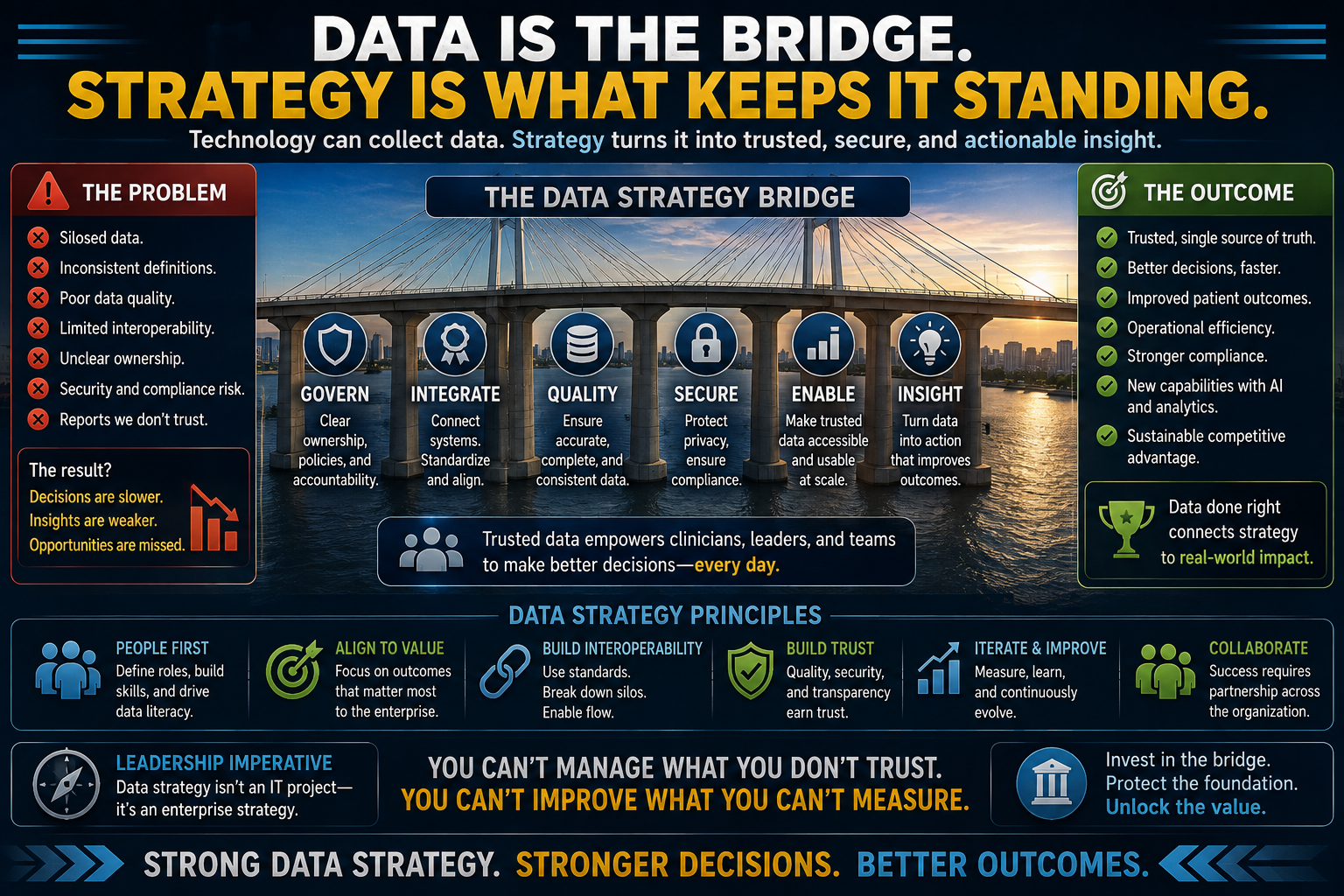
Healthcare organizations generate extraordinary amounts of data. Clinical data. Imaging data. Operational data. Financial data. Device data. Patient-generated data. And increasingly, data created and consumed by artificial intelligence. But having more data does not automatically create more value. In many organizations, data remains fragmented across applications, departments, platforms, and workflows. Definitions differ. Ownership is unclear. Quality varies. Access is inconsistent. Teams spend significant time reconciling information before they can trust it enough to make decisions. The challenge is not simply collecting data. It is creating an enterprise strategy that makes data usable, trustworthy, secure, and actionable. That requires several capabilities working together. Governance establishes ownership, accountability, policies, and decision rights. Integration connects information across clinical and operational systems. Data quality ensures information is accurate, complete, consistent, and timely. Security and privacy protect information while allowing appropriate access. Enablement makes trusted data available to the people and systems that need it. Analytics and AI turn that foundation into insight and action. When these capabilities are disconnected, organizations build more technology without necessarily improving decision-making. When they work together, data becomes a bridge between strategy and execution. Clinicians gain better information at the point of care. Operational leaders identify opportunities faster. Executives make decisions with greater confidence. AI initiatives begin with stronger foundations. And organizations can measure whether transformation is actually improving outcomes. This is why data strategy should not be treated as an IT project. It is an enterprise capability. It requires participation from clinical leadership, operations, technology, security, finance, analytics, and governance. Technology can collect and process information. But technology alone cannot determine what data means, who owns it, how trustworthy it is, or how it should be used. Those are organizational decisions. And increasingly, they are strategic decisions. Healthcare organizations do not need more data simply for the sake of having it. They need trusted information that connects decisions to outcomes. Data is the bridge. Strategy is what keeps it standing.

Leave A Comment

Your email address will not be published. Required fields are marked *