Enterprise Imaging Governance: The Missing Layer Between Technology and Enterprise Value
Healthcare organizations continue to invest heavily in enterprise imaging technology.
PACS platforms evolve.
VNAs expand.
Cloud adoption accelerates.
AI capabilities emerge.
Yet many organizations still struggle to realize the value of these investments fully.
The challenge is often not the technology.
The challenge is governance.
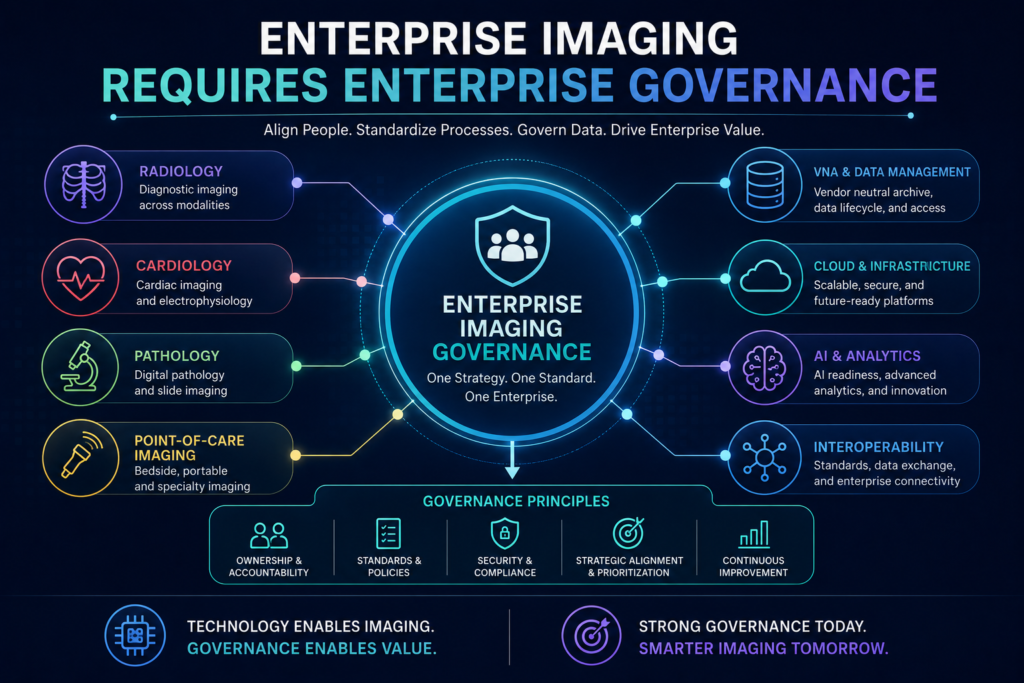
Enterprise imaging now spans multiple specialties, locations, workflows, and stakeholders.
Radiology.
Cardiology.
Pathology.
Point-of-care imaging.
Specialty clinical departments.
As imaging expands, so does complexity.
Without governance, organizations frequently encounter:
- Inconsistent imaging standards
- Fragmented workflows
- Unclear ownership
- Redundant investments
- Limited interoperability
- Conflicting priorities
Technology alone cannot solve these challenges.
Governance provides the structure that aligns people, processes, and technology around common objectives.
Organizations that mature successfully establish enterprise imaging governance models that define:
- Data ownership
- Operational accountability
- Imaging standards
- Retention policies
- Interoperability requirements
- Strategic investment priorities
This alignment creates consistency across departments while supporting long-term scalability.
More importantly, it allows imaging to function as an enterprise capability rather than a collection of departmental systems.
As AI, analytics, and enterprise interoperability continue to expand, governance will become one of the most important determinants of imaging success.
Technology enables imaging.
Governance enables enterprise value.
Organizations that focus on both will be best positioned to scale and innovate in the years ahead.