

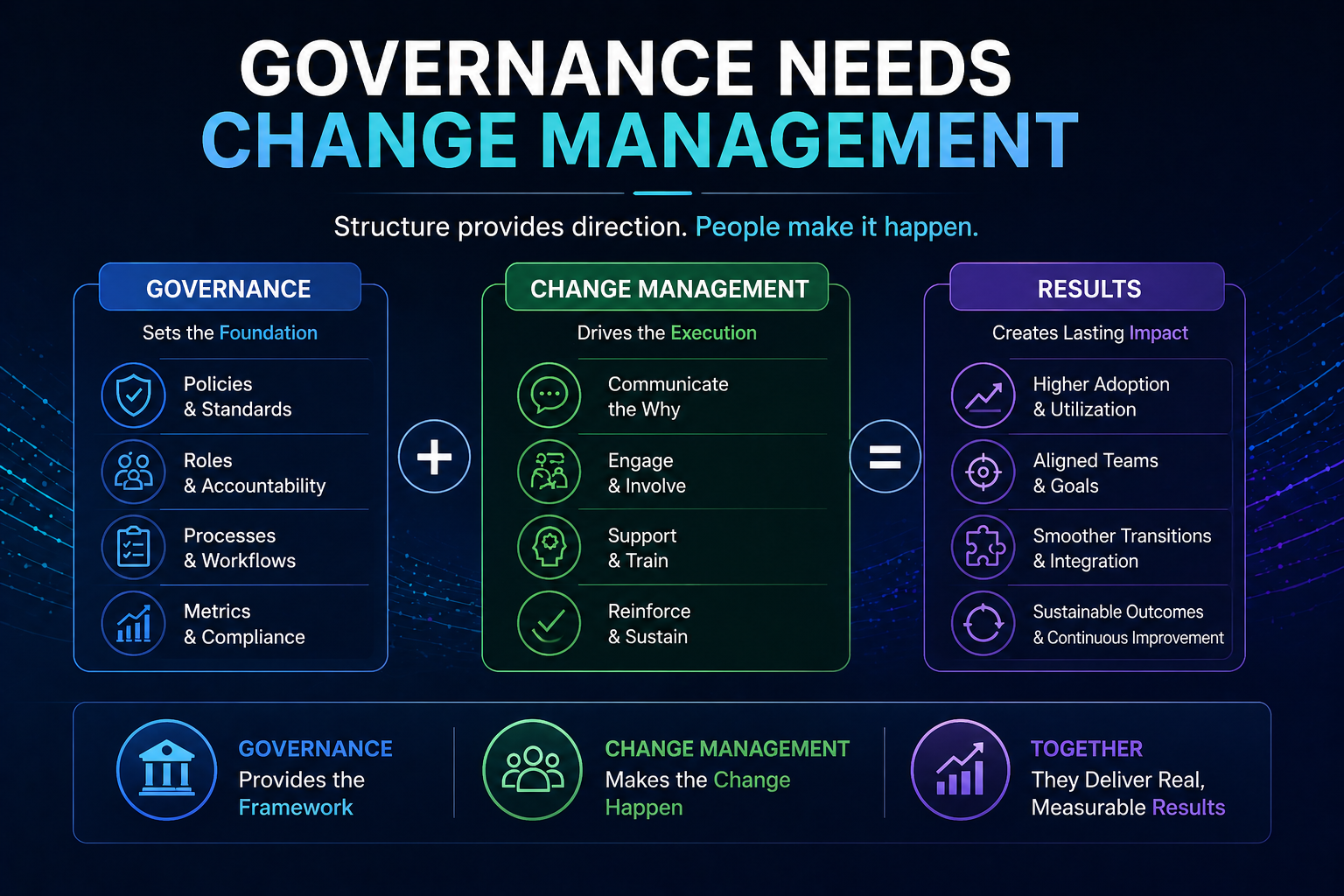
Governance is often positioned as the foundation for scaling technology in healthcare.
And it is.
But governance alone is not enough.
Organizations can define decision-making structures, establish policies, and align leadership across clinical and IT teams — and still struggle to see meaningful adoption.
Because governance doesn’t drive change.
People do.
And without a structured approach to change management, even the best-designed governance models can fail in execution.
New workflows are introduced.
Expectations shift.
Responsibilities evolve.
But if teams are not aligned, engaged, and supported through that change, resistance becomes inevitable.
In many organizations, the gap isn’t in strategy.
It’s in adoption.
Successful organizations recognize that governance and change management must operate together.
They don’t treat change management as a downstream activity.
They integrate it from the beginning.
They communicate clearly across clinical and operational teams.
They define not just what is changing, but why it matters.
They provide the support structures needed to transition workflows effectively.
And they ensure accountability is reinforced not just through governance, but through engagement.
In these environments, governance becomes actionable.
Not just defined — but lived.
Scaling technology isn’t just about systems and structure.
It’s about people.
And without aligning both, organizations often find themselves with well-designed strategies that never fully translate into outcomes.
Governance creates the framework.
Change management makes it real.