

Healthcare organizations are moving quickly to explore and adopt artificial intelligence.
New tools are being evaluated.
Proofs of concept are being launched.
Vendors are promising transformation.
On the surface, it feels like momentum.
But beneath the surface, many organizations are not truly ready.
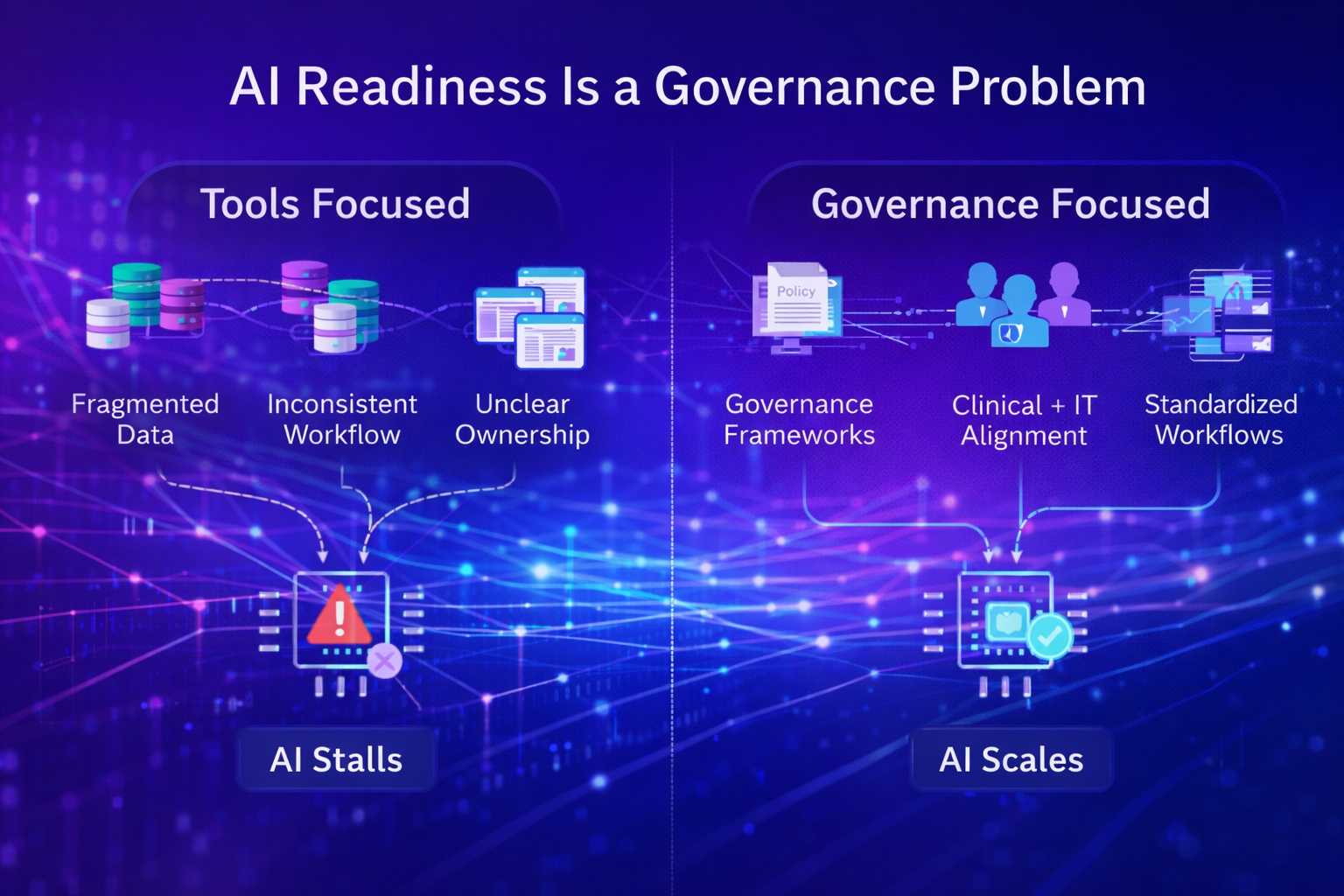
Because AI readiness isn’t a technology problem.
It’s a governance problem.
Without the right foundation in place, even the most advanced AI solutions struggle to scale. Data remains fragmented. Workflows vary across departments and sites. Ownership is unclear. Accountability is inconsistent.
And when those conditions exist, AI doesn’t fail because of the model — it fails because the organization isn’t structured to support it.
Organizations that successfully scale AI take a different approach.
They don’t start with tools.
They start with structure.
They establish governance frameworks that define how decisions are made.
They align clinical and IT leadership around shared ownership.
They standardize workflows to reduce variability across environments.
They build data strategies that support enterprise-level visibility and performance.
In these environments, AI becomes an extension of an already well-functioning system — not a disconnected add-on.
The conversation often starts with:
“What AI solution should we implement?”
But the more important question is:
“Is our organization ready to support AI at scale?”
That’s where transformation actually begins.
—
If you’re exploring enterprise imaging strategy, AI readiness, or clinical systems transformation, you’re part of conversations happening across many organizations today.