Who Supports the Healthcare AI Tool After the Pilot Ends?
A healthcare AI demonstration ends with a promising result. The draft appears, the user reviews it, and the workflow moves forward.
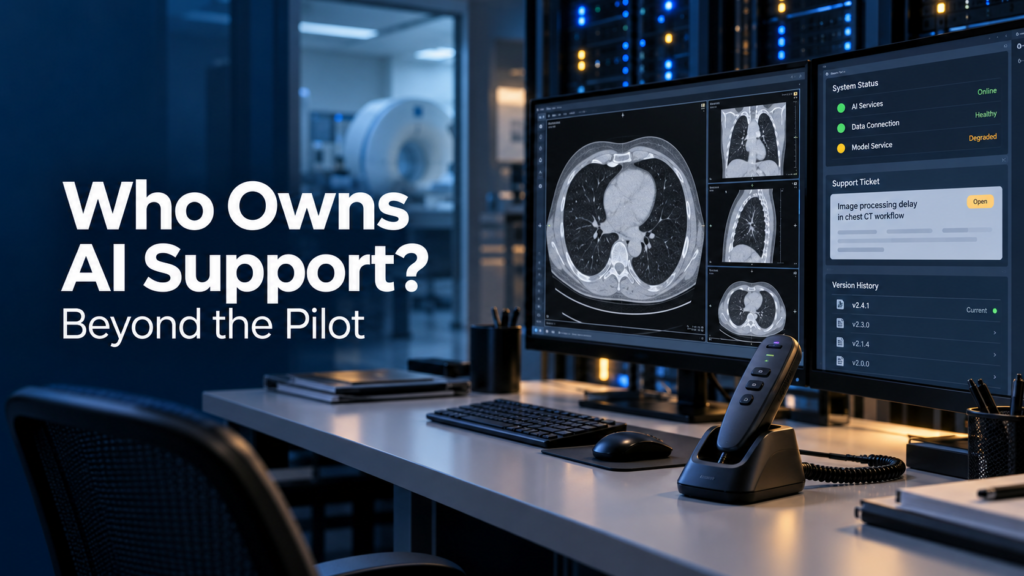
Now consider a different moment: the service stops responding during a busy shift. A template behaves differently after an update. An integration delivers incomplete information.
Who receives the call, who coordinates the response, and how does the user continue working?
Those questions belong in pilot planning. A demonstration can show a capability. Moving into daily operations requires a support model that people understand and can use.
Name the owner of the service
AI support may involve an application team, infrastructure, integration specialists, a vendor, and clinical or operational leaders. Each may own a component without owning the overall service.
Assign an accountable service owner and document the responsibilities around that role. Identify the technical support lead, the workflow owner, the vendor escalation route, and the person authorized to coordinate changes or suspend the affected function.
One person may hold several responsibilities. Each responsibility still needs a named owner and a backup.
Give users one clear way to report a problem
Users should not need to decide whether a problem belongs to speech recognition, a model, a template, or an interface before asking for help.
Establish a clear support entry point. Define what information helps investigation, such as the time of the event, the affected function, the software version, and an approved reference to the incident. Follow organizational rules for handling clinical information; avoid copying patient details into unapproved support channels.
Support teams can then route the investigation while keeping the user informed about the operational response.
Plan how work continues
For each AI-assisted step, define the approved fallback when assistance is unavailable or its output cannot be accepted. In a reporting workflow, that might involve an established manual reporting process, according to local procedures.
Make clear what has been saved, what remains a proposal, and what still needs review. Recovery should not silently replace a user’s edits or create duplicate submissions.
Clinical and operational owners should agree on when to pause the affected function and when it can resume. Urgent concerns continue to follow established patient-safety and escalation procedures.
Treat changes as changes to a workflow
A model update is only one possible source of changed behavior. Speech settings, prompts, templates, interfaces, and connected applications may also affect the result.
Keep a record of the versions and configurations used together. Identify who reviews a proposed change, which test cases must be repeated, and what evidence is needed before releasing it to the intended users.
Include a way to return to a previously accepted configuration where feasible. If rollback is unavailable, document the alternative, including when assistance must remain paused.
Measure the work after review and correction
A fast draft is a useful observation, but it does not describe the complete task. Include the time users spend reviewing, correcting, recovering from interruptions, and obtaining support.
Choose measures that fit the intended workflow. These may include task completion time, correction effort, service interruptions, support demand, and unresolved exceptions. Define how issues affecting output quality are reviewed by the appropriate qualified people.
Compare results with the baseline and intended acceptance criteria. Feedback should have an owner, a review cadence, and a route to a decision—not simply a growing list of requests.
Make the transition out of a pilot explicit
Before expanding use, review the intended scope, evaluation results, known limitations, support coverage, training, fallback process, and ongoing operating costs.
Confirm who accepts responsibility for the service. A pilot may appropriately continue under limited conditions, require further work, or stop. The transition should be a deliberate decision supported by evidence.
A focused custom application or integration can address a practical gap, but its maintenance and support responsibilities need the same attention as its features.
Build operational ownership alongside the technology
At InsightBridge Technologies, we bring healthcare IT experience together with integration planning, custom software development, and AI exploration. We consider how a solution will fit into daily work and how it will be supported as it changes.
Our IB AI Reporting prototype remains in development and testing. It is not a clinically validated production service. Editable reports, clinician review, and evaluation of workflow behavior remain central considerations as the work progresses.
Before your next healthcare AI pilot expands, can your team name who owns support, how users continue working, and who approves the next change?