Before You Build Another Healthcare Dashboard, Define the Decision
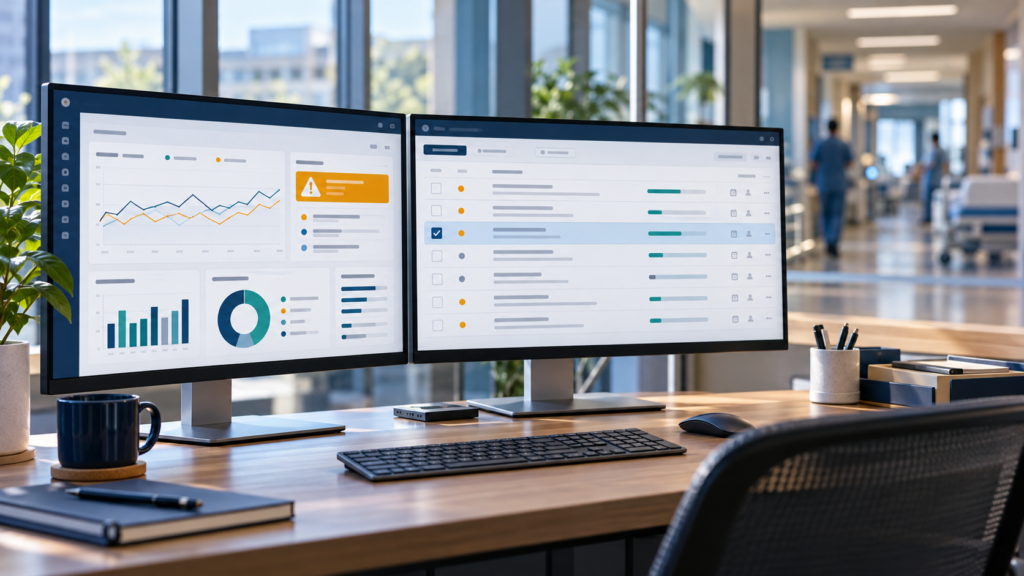
A request for a new dashboard often begins with a reasonable concern: leaders cannot see what is happening across the workflow.
One team tracks requests in a spreadsheet. Another watches an application queue. A third prepares a weekly report. The proposed solution is to put the information on one screen.
That may help. Before designing the screen, however, define the decision someone needs to make—and what happens after they make it.
Start with a decision, a person, and a time
“Improve visibility” is difficult to evaluate. A more useful starting point is a specific question: which interface exceptions need an assigned owner before the next shift begins?
Name the person who will act, the information they need, and how quickly it must be available. A daily management review and an operational escalation queue need different levels of detail and freshness.
If nobody can describe the action, the request may need further discovery before development begins.
Agree on what the measure means
Two systems can display the same label while counting different things. A completed request might mean received by an interface, accepted by an application, or reviewed by a user.
Document the definition, source, included population, exclusions, and relevant timestamps. Identify who owns the definition and who resolves disagreements between sources.
A technically correct query can still answer the wrong operational question. Review sample records with the people who perform the work before treating a measure as authoritative.
Show missing and delayed information
A clear screen can create false confidence if it hides uncertainty. A zero count is not the same as an unavailable feed. Yesterday’s successful refresh does not establish that the current workflow is healthy.
Display the last successful update and make missing or delayed data visible. Define how the team responds when the information cannot be trusted.
Where sources disagree, show the exception or explain the reconciliation rule rather than silently choosing a value.
Connect the observation to an action
Consider an exception list that shows delayed work but offers no way to assign responsibility. Users may still need to copy details into email, locate the right team, and maintain a separate follow-up list.
The practical gap may be an integration, a focused custom application, or a clearer operating process. A dashboard can support that process, but it does not create ownership by itself.
Define the route from observation to assignment, escalation, resolution, and review. Consider access permissions and organizational information-handling rules when deciding what users can see and share.
Use AI where its output can be checked
AI may help summarize an exception list or organize operational notes. Those possibilities still need evaluation against the intended task.
Keep the underlying records available to authorized reviewers. Distinguish generated summaries from source facts, and make it possible to correct or reject a summary. An explanation of a trend should not be treated as an established cause without supporting evidence.
At InsightBridge Technologies, our IB AI Reporting prototype remains in development and testing. It is not a clinically validated production service. Its focus on editable drafts and clinician review reinforces a broader design question: can the intended user inspect and control the output before relying on it?
Evaluate the complete workflow
Before rollout, record a baseline for the decision or task being improved. Depending on the use case, useful measures may include time to assign an exception, unresolved items, duplicate follow-up, or effort spent reconciling reports.
Agree on acceptance criteria and review the result with users. Include the effort required to maintain definitions, integrations, permissions, and the application itself.
More charts and more visits do not, by themselves, establish that the work has improved.
Build around the work that needs to happen
InsightBridge Technologies brings healthcare IT experience together with integration planning, custom software development, and AI exploration. We start with the workflow, the responsible people, and the information needed to support a practical decision.
Before approving your next dashboard, ask: who will make which decision, using what information, and what will happen next?