

Healthcare organizations rarely become operationally unstable all at once.
Complexity accumulates gradually.
New systems are added.
New workflows emerge.
Departments evolve independently.
Temporary operational decisions become permanent structures.
Over time, complexity becomes embedded into the organization itself.
And eventually, scalability slows.
Many transformation initiatives struggle not because organizations lack technology or talent — but because operational complexity has quietly outpaced organizational alignment.
Workflows vary across locations.
Governance structures become inconsistent.
Data definitions diverge.
Operational ownership becomes fragmented.
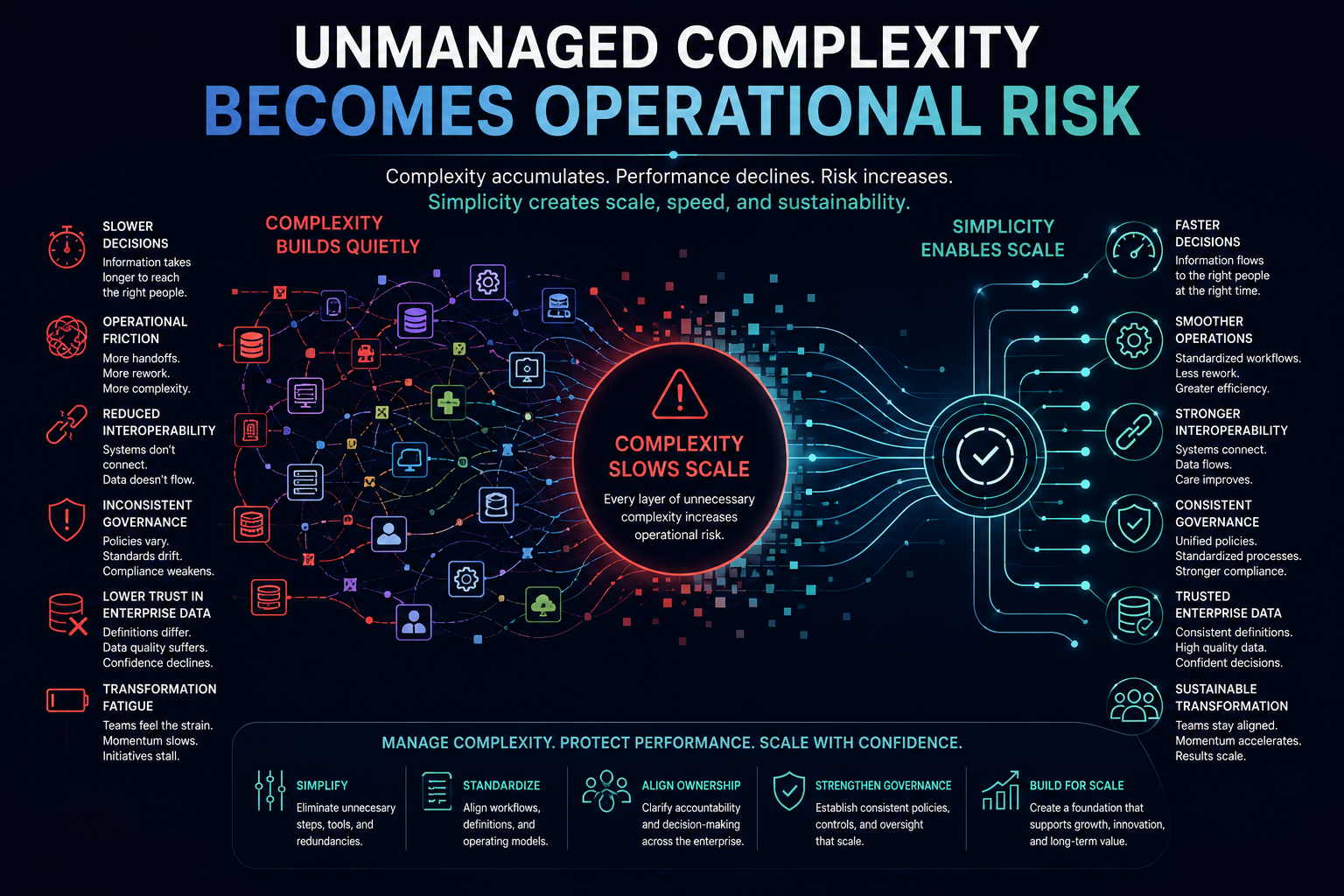
As complexity grows, organizations experience a common pattern:
- Slower decision-making
- Increased operational friction
- Reduced interoperability
- Lower trust in enterprise data
- Transformation fatigue across teams
This becomes especially critical in enterprise imaging, AI adoption, cloud transformation, and multi-site healthcare operations — where scalability depends on consistency and operational clarity.
Organizations that scale successfully treat complexity as a strategic operational risk.
They simplify workflows.
They standardize governance.
They align operational ownership.
They reduce unnecessary variability across systems and environments.
Because scalability is not created by adding more complexity.
It is created by intentionally managing complexity.
Transformation becomes sustainable when organizations simplify enough to scale effectively.
The greatest operational risk is often not the technology itself.
It is the uncontrolled complexity surrounding it.
#OperationalExcellence
#HealthcareIT
#DigitalTransformation
#EnterpriseTransformation
#ITGovernance
#HealthTech
#OperationalStrategy