

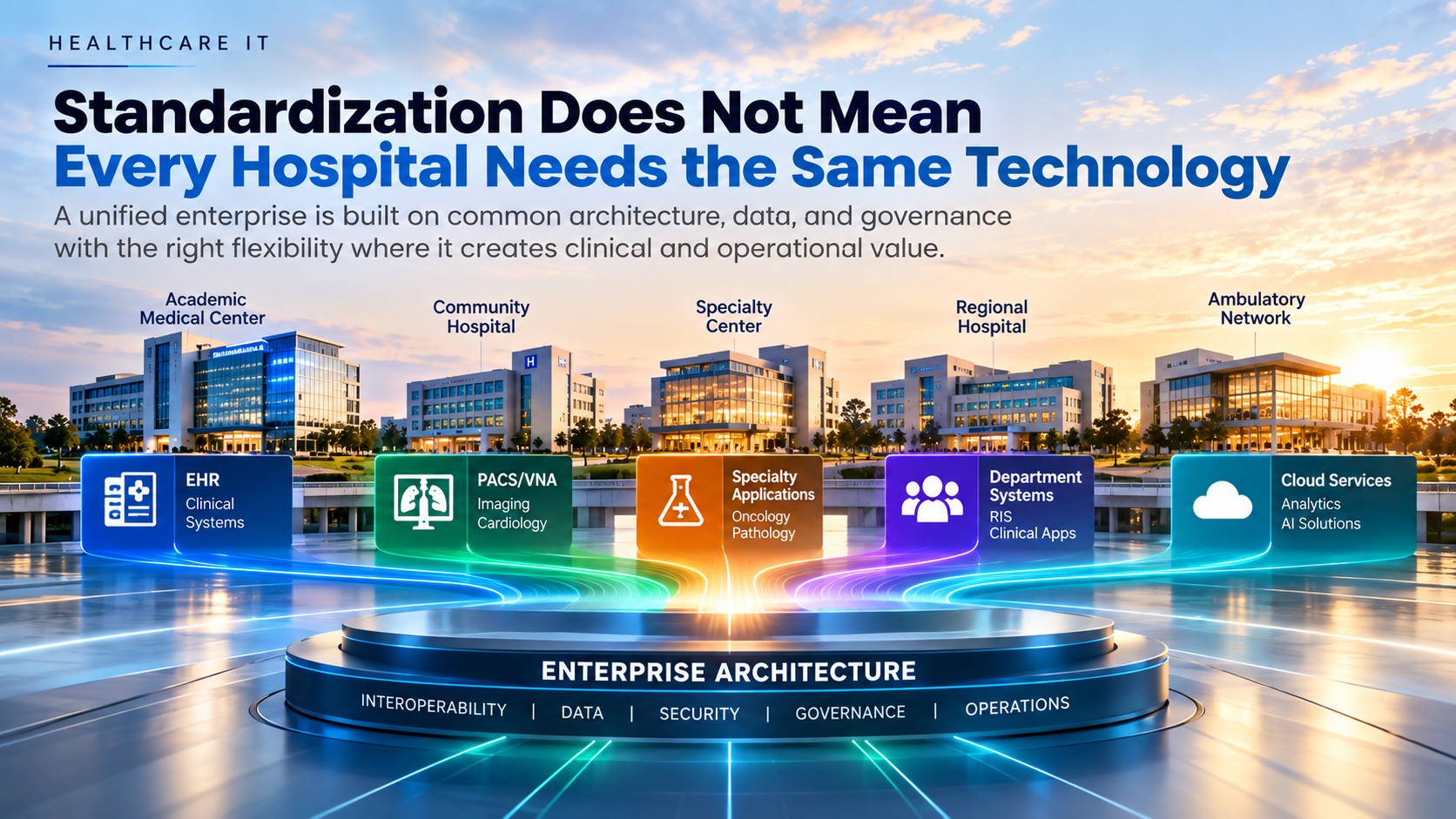
“Why can’t every hospital just use the same system?”
It is a reasonable question, especially for health systems managing multiple hospitals, acquisitions, specialty services, and rising technology costs.
Standardization can reduce complexity, simplify support, strengthen security, and improve purchasing leverage. But there is an important distinction that gets lost in many consolidation discussions:
Standardization is not the same as making everything identical.
A community hospital, academic medical center, ambulatory network, and highly specialized clinical service may share enterprise obligations without having identical clinical requirements.
The leadership challenge is deciding where consistency creates value, where variation is justified, and how to govern both.
Start With What the Enterprise Needs to Have in Common
Enterprise standardization should begin with capabilities and operating expectations—not a mandate that every department adopt the same application.
Common standards often deliver substantial value across:
- Identity and access management, including role-based access and lifecycle controls.
- Cybersecurity, privacy, auditability, and resilience requirements.
- Interoperability patterns, interfaces, APIs, and data exchange expectations.
- Data definitions, ownership, quality, and authoritative sources.
- Monitoring, incident response, support accountability, and service levels.
- Architecture review, vendor assessment, and technology lifecycle governance.
These shared expectations make an environment more supportable even when clinical applications differ. They also make future integrations, acquisitions, and modernization efforts less dependent on one-off decisions.
Recognize Where Clinical Variation Is Legitimate
Not every difference is technical debt.
Specialty imaging, advanced cardiology, oncology, pathology, research, and highly specialized procedural workflows may need capabilities that a general-purpose enterprise platform cannot adequately deliver.
The question should not be whether an application is different. It should be whether that difference creates measurable clinical or operational value that justifies its cost and complexity.
A specialty system might be justified because it supports a critical workflow, improves diagnostic capability, meets a specific regulatory requirement, or enables a service the enterprise standard cannot support.
But “we have always used it” is not, by itself, a compelling business case.
Every Exception Creates an Enterprise Obligation
Even a justified exception has a lifecycle.
It requires integration, security review, identity management, monitoring, vendor coordination, training, upgrades, disaster recovery planning, and eventually a replacement or retirement strategy.
These obligations should be visible when an exception is approved—not discovered after implementation.
For leadership, the decision is not simply the purchase price of a specialty platform. It is the total cost and risk of operating that platform as part of the enterprise.
Govern Variation Instead of Letting It Accumulate
Strong governance makes exceptions deliberate rather than accidental.
A practical review asks:
- What clinical or operational requirement cannot be met by the existing standard?
- What evidence supports the value of a different solution?
- Can the solution meet enterprise security, data, and integration requirements?
- Who owns the operational and financial obligations over its lifecycle?
- When will the exception be reviewed again?
Approval should establish accountability, not create a permanent exemption from architecture and operating standards.
This approach also prevents standardization programs from becoming purely vendor-consolidation exercises. A smaller application count is useful only if the resulting environment actually improves cost, resilience, clinical workflow, or strategic flexibility.
Measure the Outcome, Not Just the Number of Systems
Counting retired applications is easy. Understanding whether standardization made care delivery and technology operations better requires broader measures.
Leaders should examine integration reliability, support effort, cybersecurity exposure, data consistency, clinical workflow impact, total cost of ownership, and the effort required to implement future change.
A health system with a few carefully governed specialty platforms may be more effective than one that forces every service into a single application while creating workarounds and hidden operational costs.
The Goal Is a Manageable Enterprise
The strongest enterprise technology strategy does not begin with “one system for everyone.” It begins with clear standards, explicit decision rights, and an understanding of where differentiation matters.
Consistency should simplify the enterprise. Flexibility should serve a justified purpose. Governance should connect the two.
Standardize where consistency creates value. Allow variation where variation creates value. Govern the difference.