

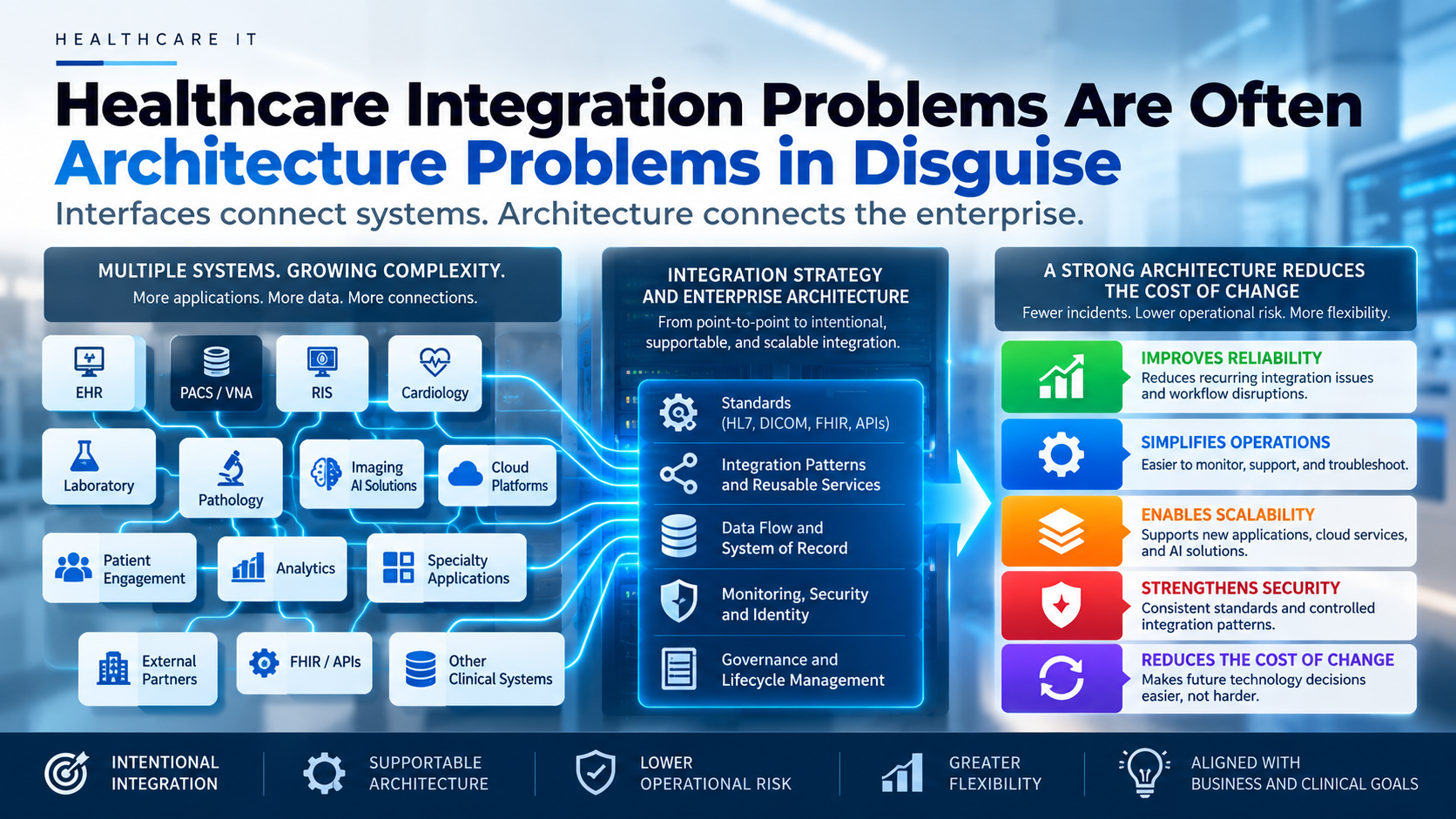
Healthcare organizations rarely describe their challenges as architecture problems.
Instead, they describe the symptoms.
An order did not reach the downstream system.
A result appeared in one application but not another.
Patient information does not match across platforms.
A new application requires another custom interface.
A workflow depends on staff manually moving information between systems.
The immediate response is often to investigate the interface.
And sometimes, the interface really is the problem.
But when the same types of integration issues continue appearing across an organization, the underlying problem may be much larger.
It may be the architecture.
Interfaces Connect Systems. Architecture Connects the Enterprise.
Healthcare technology environments are inherently complex.
EHRs, PACS, VNAs, laboratory systems, cardiology platforms, specialty applications, cloud services, patient engagement tools, analytics platforms, and increasingly AI solutions all need to exchange information.
Standards such as HL7, DICOM, FHIR, and APIs make that exchange possible.
But standards alone do not create good architecture.
An organization can have hundreds of technically functional interfaces and still have a fragmented technology environment.
That happens when integration decisions are made one project at a time without considering the broader enterprise.
A new system needs data, so another interface is built. A department needs a workflow, so another point-to-point connection is added. A vendor introduces a cloud platform, so another integration pattern is created.
Individually, each decision may make sense.
Collectively, they can create an environment that becomes increasingly difficult to understand, support, secure, and change.
The Cost of Integration Complexity Is Easy to Underestimate
The cost of an interface is not limited to building it.
Every connection creates a long-term operational dependency.
Someone must monitor it. Someone must troubleshoot it. Someone must understand the transformation logic. Someone must test it when either system changes. Someone must determine what happens when messages fail. And someone must understand which clinical workflows depend on it.
Multiply that across hundreds of integrations, and architecture decisions made years ago begin affecting today’s operating model.
This is why integration complexity eventually becomes more than a technical concern.
It becomes an operational risk.
Look for Patterns, Not Just Incidents
When an interface fails, the immediate priority is restoring the workflow.
But after the incident is resolved, organizations should ask a second question:
Why does our environment make this type of failure possible—or difficult to resolve?
Recurring symptoms can reveal broader architectural issues:
- Multiple systems maintaining different versions of the same information.
- Point-to-point integrations that have grown without a consistent integration strategy.
- Custom transformations that few people understand.
- Applications that require extensive integration simply to participate in standard workflows.
- Interfaces with unclear ownership or inadequate monitoring.
- Critical workflows dependent on technology that was originally intended as a temporary solution.
The individual incident matters.
The pattern matters more.
Architecture Should Reduce the Cost of Change
One of the best tests of an architecture is not whether it works today.
It is how difficult it is to change tomorrow.
Healthcare organizations will continue replacing applications, adopting cloud platforms, expanding interoperability, introducing AI, and consolidating technology.
If every change requires rebuilding a large portion of the integration environment, the architecture is creating friction rather than reducing it.
Good enterprise architecture establishes reusable patterns.
It clarifies how systems should exchange information. It defines where data should originate and which systems should be authoritative. It reduces unnecessary point-to-point dependencies. It establishes standards for monitoring, security, identity, and data movement.
Most importantly, it makes future technology decisions easier rather than harder.
Integration Strategy Is Becoming Even More Important
Healthcare integration is expanding beyond traditional application-to-application connectivity.
Organizations now need to connect clinical platforms with cloud environments, analytics ecosystems, AI services, patient-facing applications, and external partners.
That makes architectural discipline increasingly important.
Adding another API does not automatically create interoperability.
Adding another integration engine does not automatically reduce complexity.
And connecting another application does not necessarily improve the workflow.
The question should not simply be:
“Can these systems connect?”
It should also be:
“Does this connection move us toward the architecture we want to operate?”
That distinction changes integration from a project activity into an enterprise capability.
From Interface Management to Architecture Management
Healthcare organizations will always need strong interface engineering.
But organizations also need to recognize when recurring integration problems are telling them something about the architecture underneath.
Fixing the interface restores today’s workflow.
Improving the architecture reduces the likelihood that tomorrow’s change creates another fragile dependency.
The goal is not an environment with fewer connections.
The goal is an environment where those connections are intentional, supportable, observable, secure, and aligned with the broader technology strategy.
That is the difference between managing interfaces and managing architecture.