

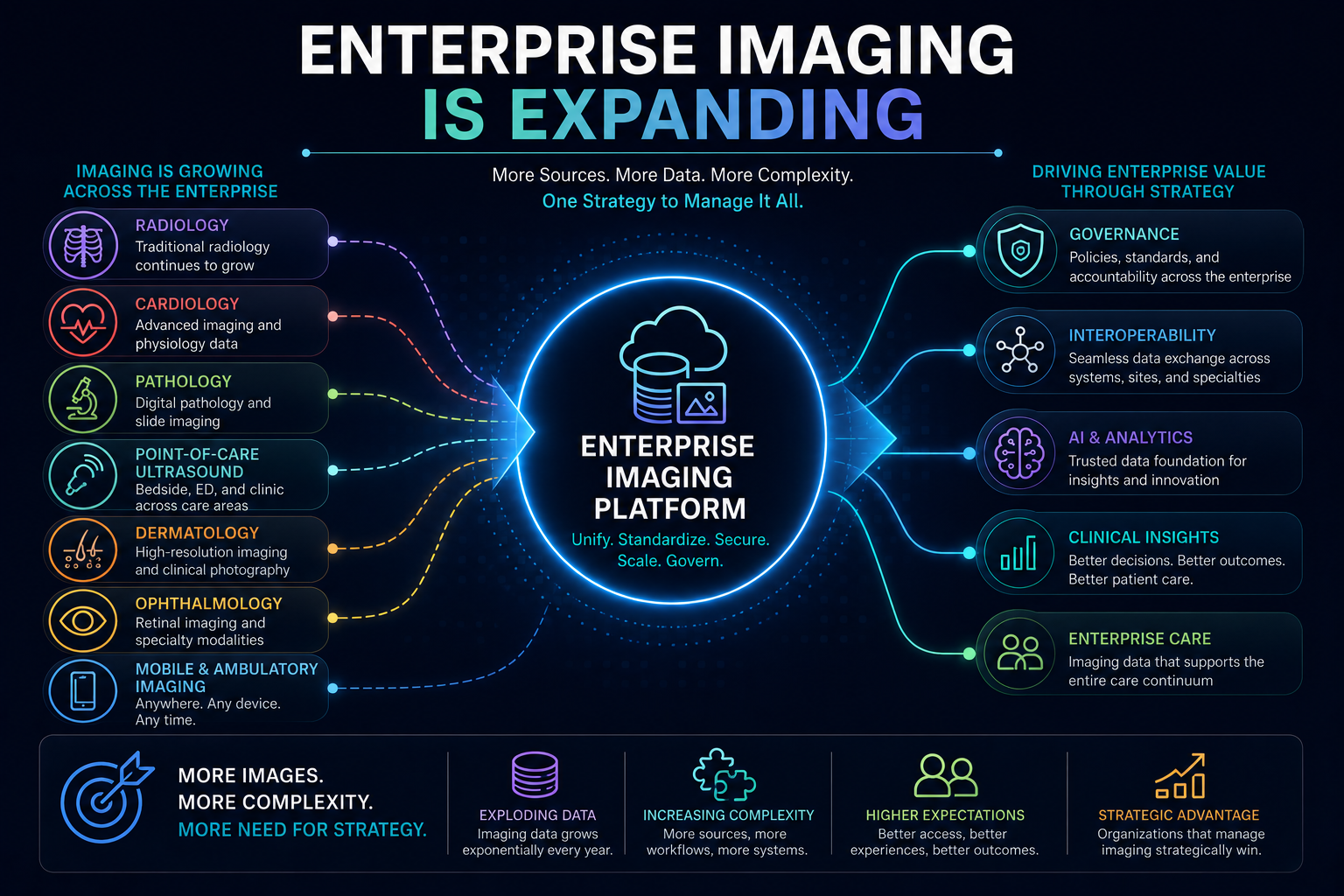
Enterprise imaging is no longer a radiology initiative.
It has become an enterprise-wide challenge.
Every year, healthcare organizations generate more imaging data from more specialties than ever before.
Radiology continues to grow.
But imaging is also expanding rapidly across:
- Cardiology
- Pathology
- Point-of-care ultrasound
- Dermatology
- Ophthalmology
- Wound care
- Mobile and ambulatory environments
The growth is significant.
The governance models often are not.
Many organizations still operate with imaging strategies originally designed for radiology-centric environments.
As imaging expands across specialties, new challenges emerge.
How is imaging data governed?
How is access standardized?
How are retention policies managed?
How is interoperability maintained across departments?
How are new imaging workflows evaluated and integrated?
Without a coordinated enterprise approach, organizations often experience fragmented imaging ecosystems that become increasingly difficult to scale.
Organizations that succeed recognize that enterprise imaging is not simply about managing more images.
It is about managing more complexity.
They establish enterprise governance.
They create scalable architecture strategies.
They align clinical, operational, and technology stakeholders.
And they build imaging platforms that support future growth, interoperability, analytics, and AI adoption.
The future of healthcare will generate more imaging data than ever before.
The organizations that thrive will not be those that collect the most images.
They will be those most prepared to manage them strategically.