

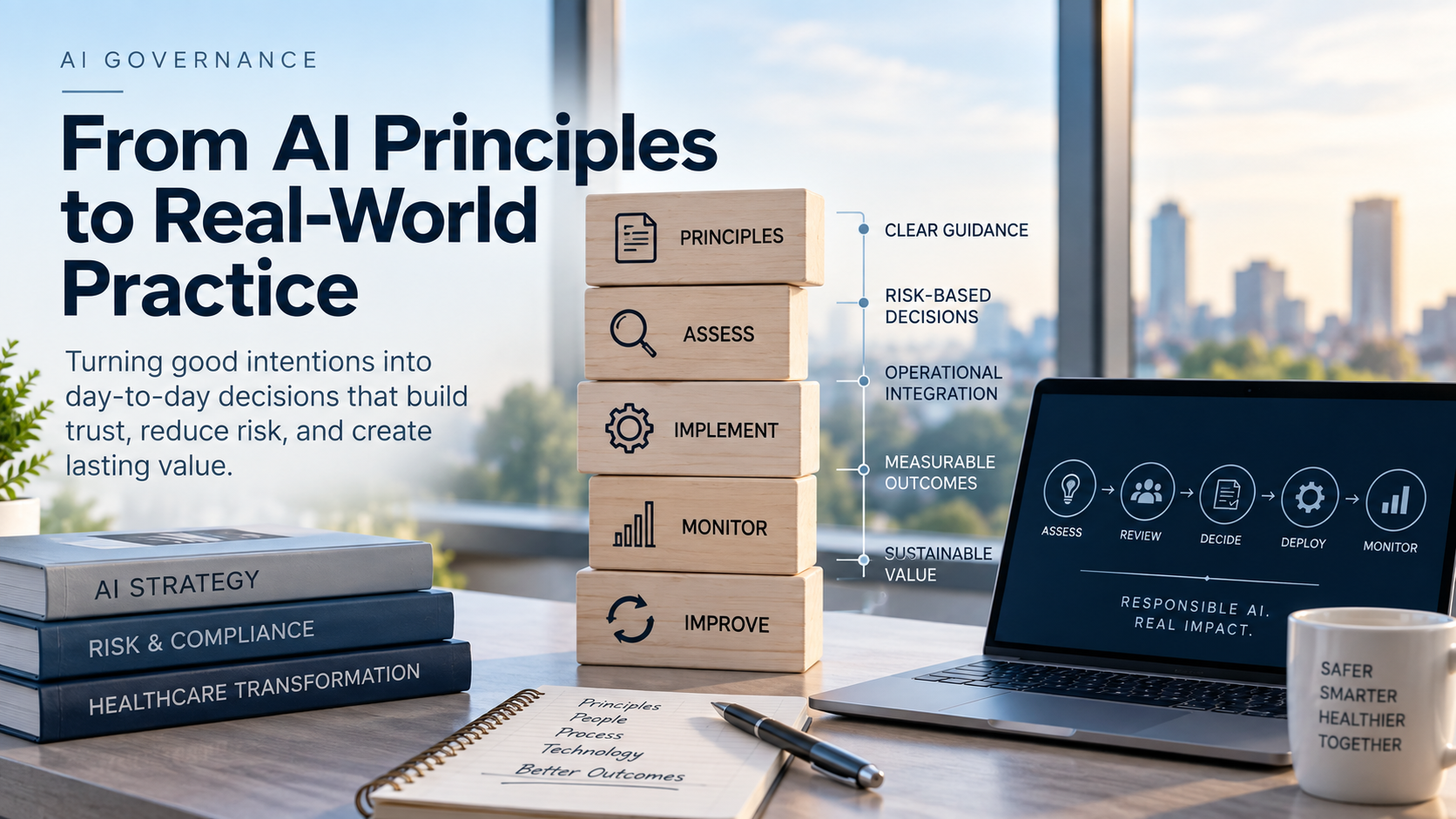
Most healthcare organizations pursuing AI do not lack principles.
They already understand the importance of safety, privacy, transparency, accountability, clinical validation, and responsible use.
The harder question is:
What happens on Tuesday morning when someone wants to deploy an AI capability?
That is where AI governance either becomes operational—or remains a document.
Principles Are Necessary. They Are Not Sufficient.
Statements such as “AI must be safe,” “AI should be transparent,” or “humans remain accountable” establish important expectations.
But principles alone do not tell a clinical leader, technology team, or product owner what to do when evaluating a real use case.
Operational governance translates those principles into repeatable actions.
If transparency matters, what documentation is required?
If safety matters, what validation must occur before deployment?
If accountability matters, who owns the outcome?
If monitoring matters, what metrics are reviewed—and who responds when performance changes?
The gap between a governance principle and an operational decision is where risk accumulates.
Put Governance Into the Workflow
Governance should not be something teams encounter only when they reach a committee.
It should be embedded throughout the AI lifecycle.
A proposed capability enters through a structured intake.
Its risk determines the appropriate review pathway.
Clinical, technical, security, privacy, and operational requirements are identified early.
Decision authority is clear.
Conditions of approval are documented.
Ownership continues after implementation.
Performance and risk are monitored.
Material changes trigger reassessment.
The objective is not to create additional bureaucracy around AI.
It is to make responsible behavior part of the normal workflow.
Make the Right Thing the Easy Thing
One of the best tests of a governance model is whether teams can actually use it.
If employees need to interpret a 40-page policy every time they encounter an AI use case, governance will eventually be bypassed.
Organizations need practical mechanisms: intake forms, risk classifications, review criteria, decision templates, defined owners, escalation paths, monitoring requirements, and clear guidance about when additional review is necessary.
The easier the organization makes the approved path to follow, the less likely teams are to create unofficial alternatives.
Governance Must Match the Risk
Operational governance also requires proportionality.
An AI tool helping an employee summarize internal meeting notes should not necessarily follow the same process as an algorithm influencing diagnosis or treatment.
Applying maximum governance to every use case creates friction without necessarily reducing meaningful risk.
Applying too little governance to high-impact use cases creates exposure.
The operating model must distinguish between them.
Governance should become more rigorous as potential impact increases.
That allows organizations to protect patients and the enterprise while still allowing lower-risk innovation to move efficiently.
Accountability Has to Survive Go-Live
One of the most important transitions occurs when an AI capability moves from project to production.
During implementation, ownership is usually obvious.
There is a project team. There are meetings. There are milestones.
After go-live, that clarity can disappear.
But AI governance cannot end when implementation ends.
Someone must remain accountable for performance, adoption, risk, vendor changes, model updates, exceptions, and outcomes.
And the organization needs predefined triggers for reevaluation.
AI is not governed because it was approved once.
It is governed throughout its lifecycle.
Measure Whether Governance Is Working
Governance itself should produce measurable outcomes.
Organizations should be able to ask whether governance is improving decision quality rather than simply increasing activity.
Useful indicators may include decision cycle time, number of use cases by risk tier, conditional approvals, exceptions, unresolved risks, monitoring compliance, reassessments, retired capabilities, adoption, and realized value.
The objective is not to measure how many governance meetings occurred.
It is to determine whether the organization is making better, faster, safer, and more accountable decisions.
From Principles to Practice
AI governance becomes valuable when people no longer need to debate how governance works every time a new use case appears.
The principles are understood.
The pathway is known.
The evidence is defined.
Decision rights are clear.
Accountability continues after deployment.
And leaders can see whether the capability is creating the intended value.
That is the transition healthcare organizations need to make:
From principles on paper to governance in practice.
At InsightBridge Technologies, we help healthcare organizations connect AI strategy, governance, enterprise architecture, clinical workflows, and operational accountability so responsible AI can move from experimentation to sustainable enterprise capability.