

Enterprise imaging is often viewed as a clinical technology initiative.
A PACS is implemented.
Storage is expanded.
A viewer is deployed.
And the conversation typically remains within radiology.
But enterprise imaging is far more than a departmental technology investment.
It is one of the largest and most strategically valuable information assets within a healthcare organization.
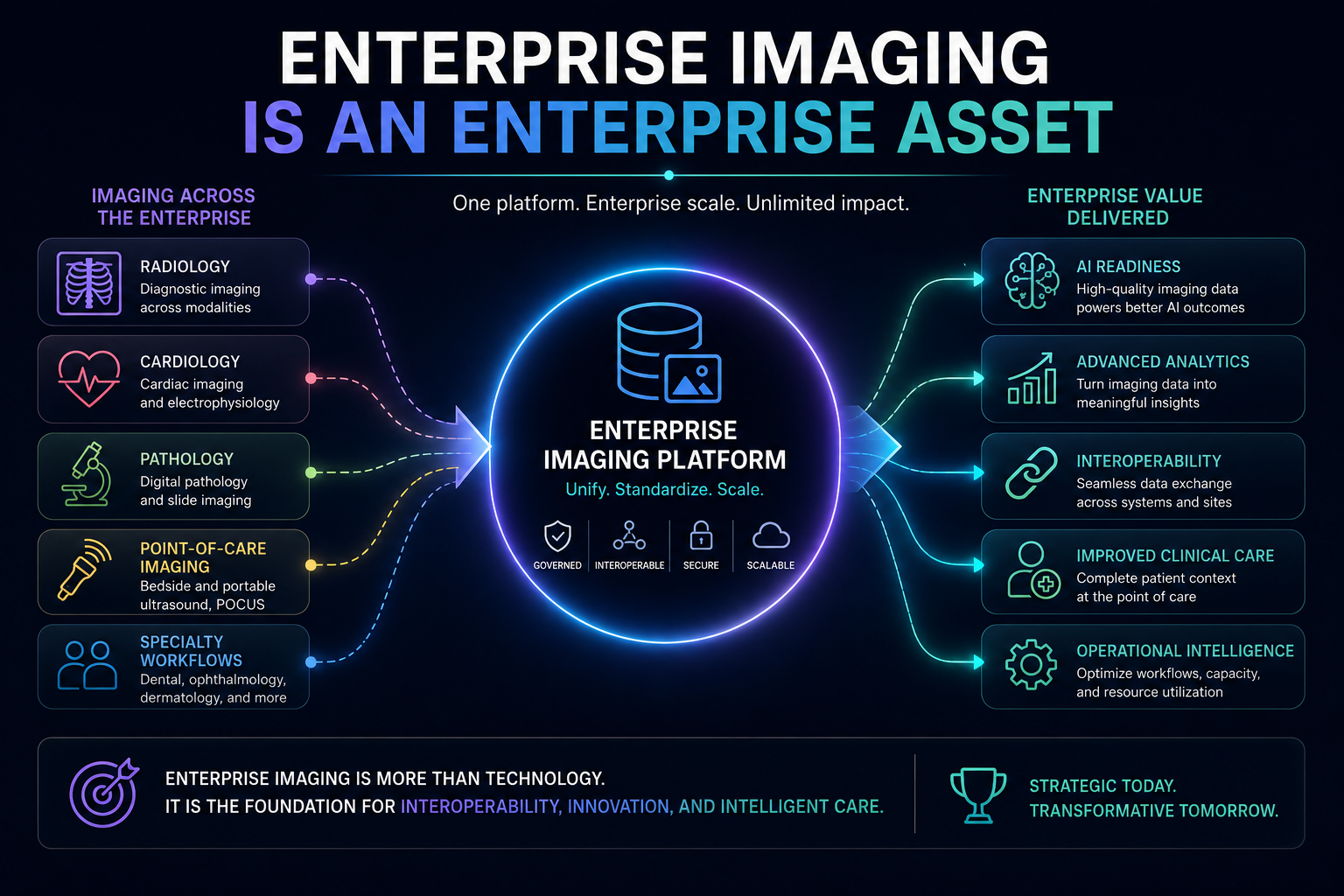
Every day, health systems generate enormous volumes of imaging data across radiology, cardiology, pathology, point-of-care imaging, and numerous specialty workflows.
These images are not simply diagnostic artifacts.
They represent clinical history, operational intelligence, longitudinal patient context, and increasingly, the foundation for future AI-enabled care delivery.
Yet many organizations continue to manage imaging through fragmented systems, siloed workflows, and department-specific strategies.
As imaging volumes grow and AI adoption accelerates, this approach becomes increasingly difficult to sustain.
Organizations that view enterprise imaging strategically take a different path.
They establish enterprise governance.
They standardize imaging workflows across specialties.
They separate data from applications through scalable architecture strategies.
They align imaging initiatives with broader clinical, operational, and digital transformation goals.
Most importantly, they recognize that enterprise imaging is no longer just about image storage and access.
It is about creating a scalable platform that supports interoperability, analytics, AI readiness, operational efficiency, and improved patient care.
The organizations that will gain the greatest value from imaging over the next decade will not be those with the most images.
They will be the ones with the most strategic imaging strategy.
Enterprise imaging is not a radiology initiative.
It is an enterprise asset.