Why Most VNA Strategies Focus on Storage Instead of Value
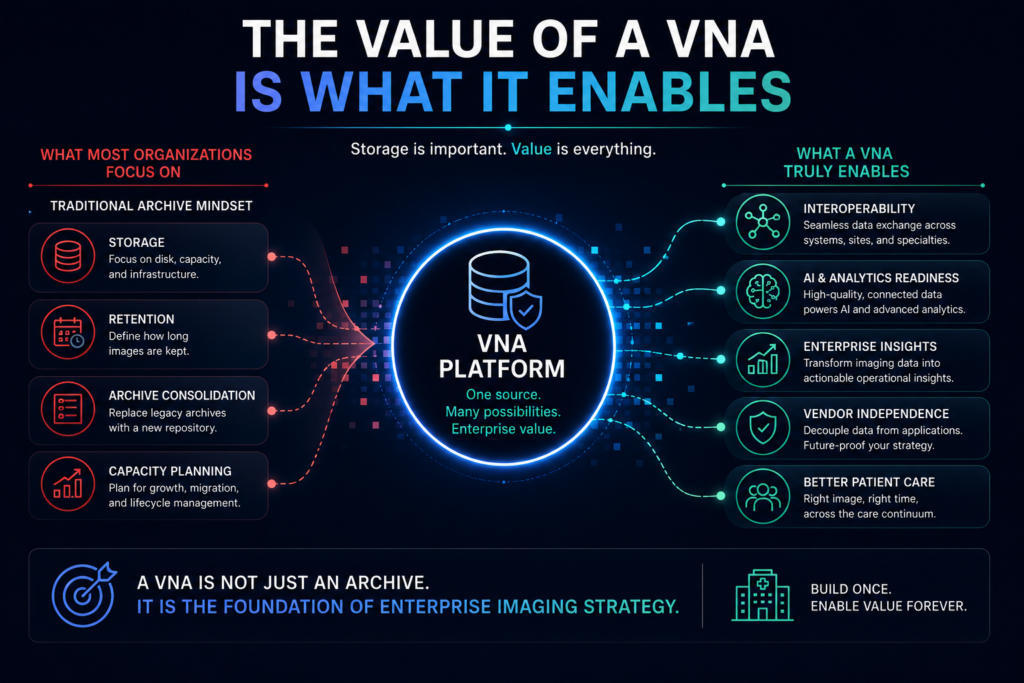
Vendor Neutral Archives (VNAs) are often discussed as storage solutions.
Organizations evaluate capacity.
Migration plans are developed.
Retention policies are reviewed.
And the conversation frequently centers around where images will be stored.
But storage is not the strategic value of a VNA.
Storage is simply the infrastructure component.
The true value of a VNA is what it enables across the enterprise.
A well-designed VNA strategy creates independence between clinical data and viewing applications.
It supports interoperability across departments and facilities.
It simplifies future migrations by reducing vendor lock-in.
It provides a foundation for enterprise imaging governance.
And increasingly, it creates the scalable data environment required for analytics, AI, and future innovation.
Organizations that focus only on storage often miss the larger opportunity.
They replace one archive with another.
The technology changes.
The operating model does not.
Organizations that extract the greatest value from VNA investments approach them differently.
They view the VNA as an enterprise platform.
They align imaging governance with enterprise data strategy.
They standardize imaging access across specialties.
They support interoperability and future application flexibility.
Most importantly, they position imaging data as a long-term strategic asset rather than a departmental repository.
The question is not where images are stored.
The question is how imaging data creates value across the enterprise.
That is where the true value of a VNA exists.