
Many healthcare organizations still approach enterprise imaging as a system upgrade.
A new PACS is selected.
Storage is expanded.
Viewers are refreshed.
And the expectation is that performance will improve.
But enterprise imaging is not a PACS upgrade.
It’s a platform strategy.
Treating it as a system replacement often leads to the same challenges reappearing over time — fragmented workflows, limited interoperability, and difficulty scaling across the enterprise.
Because the problem was never just the system.
It was the architecture.
True enterprise imaging requires a different approach.
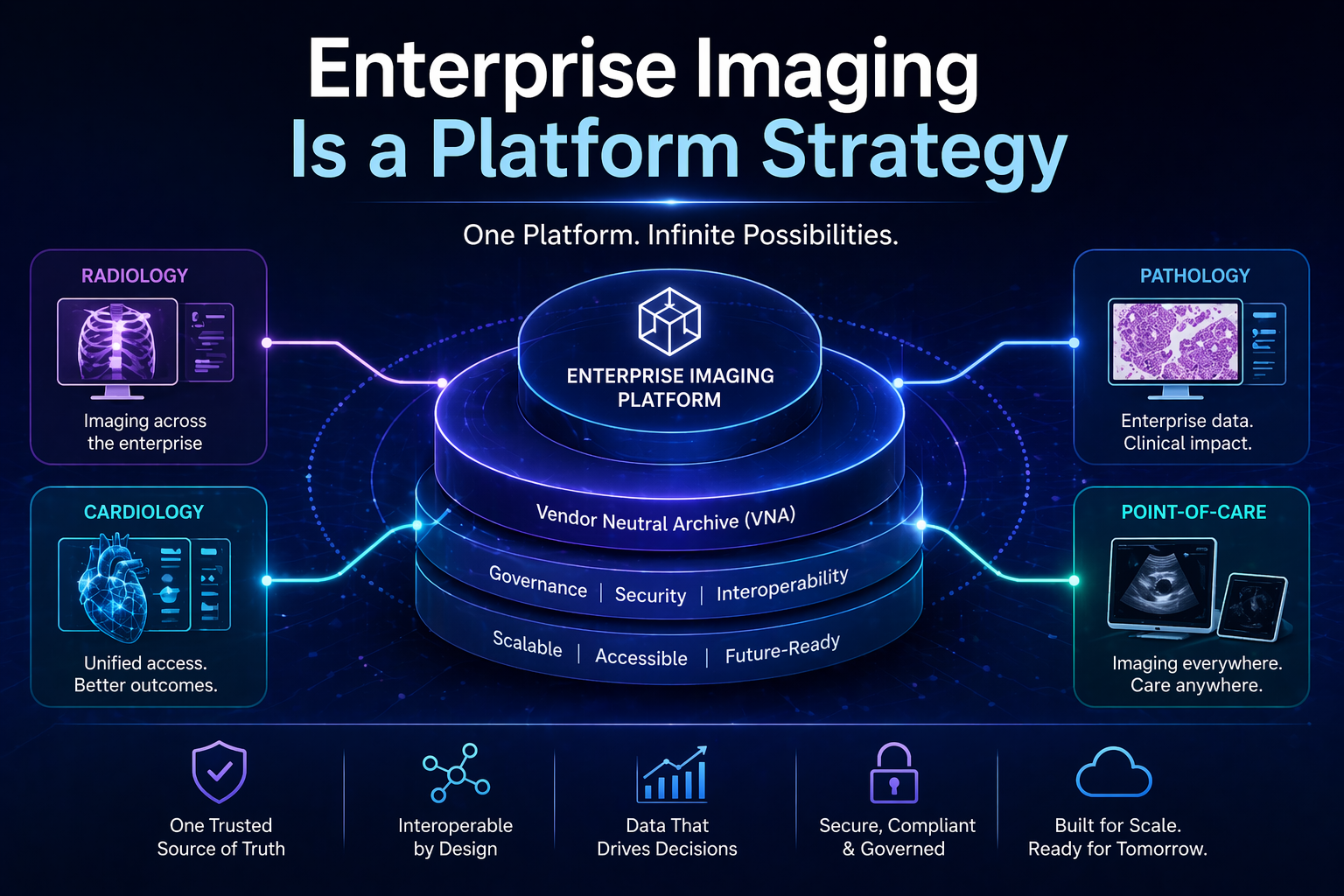
It requires thinking beyond radiology and designing a platform that supports imaging across the entire organization — cardiology, pathology, point-of-care, and beyond.
It requires a Vendor Neutral Archive (VNA) strategy that separates data from applications, enabling flexibility, scalability, and long-term control.
It requires governance that defines how imaging data is managed, accessed, and shared across clinical and operational environments.
And it requires alignment between clinical workflows, IT infrastructure, and enterprise data strategy.
Organizations that succeed don’t just replace PACS.
They redesign how imaging operates across the enterprise.
They create platforms that support growth, integration, and innovation — including AI enablement and advanced analytics.
Without that platform mindset, organizations often find themselves repeating the same cycle every few years.
With it, they build a foundation that supports long-term scalability and performance.
Enterprise imaging isn’t a project.
It’s an architectural decision.