

Artificial Intelligence continues to generate enormous excitement across healthcare.
In imaging, organizations are investing heavily in AI platforms designed to improve workflows, increase efficiency, and support clinical decision-making.
But technology alone will not deliver enterprise-scale AI success.
Standardization will.
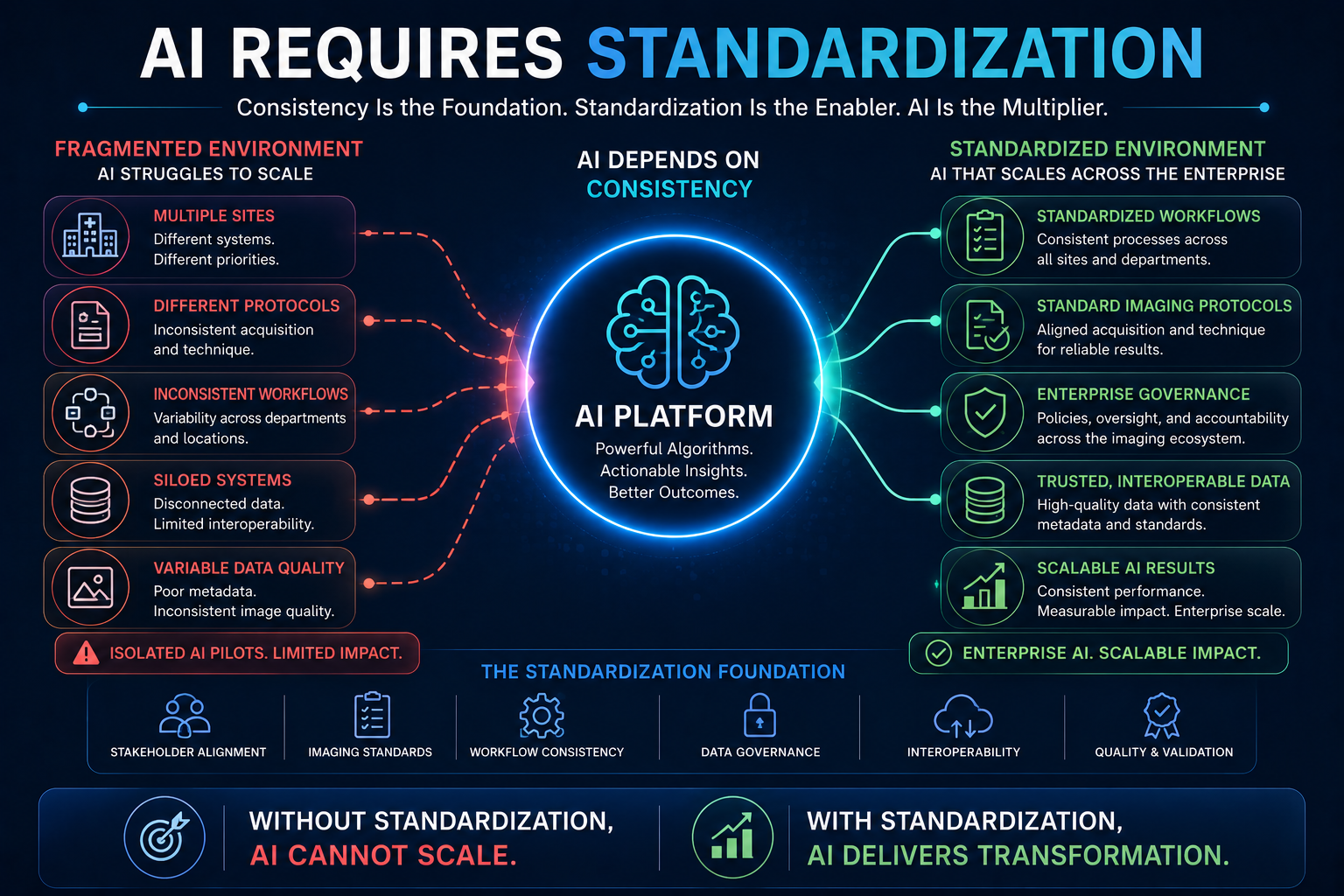
AI depends on consistency.
Consistent workflows.
Consistent metadata.
Consistent acquisition protocols.
Consistent governance.
Yet many healthcare organizations continue to operate highly fragmented imaging environments.
Different sites use different workflows.
Departments establish independent protocols.
Image acquisition standards vary.
Data quality is inconsistent.
As a result, organizations often struggle to move beyond isolated AI pilots.
The issue is rarely the AI algorithm itself.
The issue is the operational environment surrounding it.
Organizations that scale imaging AI successfully recognize that AI readiness begins long before implementation.
They standardize workflows.
They establish enterprise governance.
They align imaging standards across departments and facilities.
They create trusted, interoperable imaging ecosystems.
In these environments, AI can be deployed consistently, measured reliably, and scaled across the enterprise.
Without standardization, AI remains a collection of disconnected projects.
With standardization, AI becomes an enterprise capability.
The future of imaging AI will not be determined solely by algorithms.
It will be determined by how well organizations standardize the environments in which those algorithms operate.