

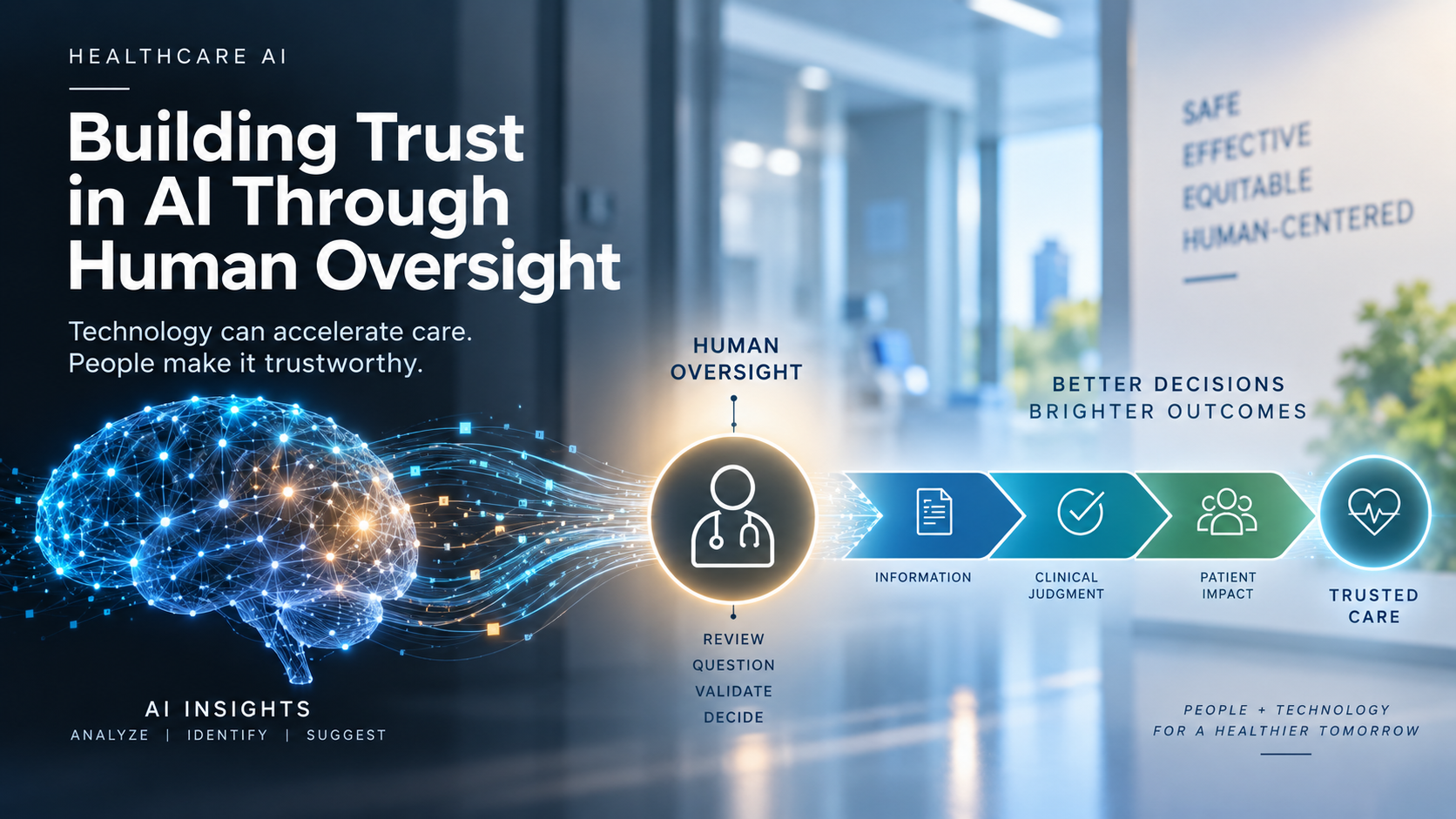
Healthcare organizations are moving quickly from experimenting with AI to embedding it into clinical, operational, and administrative workflows.
As that happens, one question becomes increasingly important:
Where should human judgment remain in the process?
The answer cannot simply be “keep a human in the loop.”
Human oversight only creates value when the organization defines who is responsible, when intervention is expected, what information people need to make a decision, and what happens when humans and AI disagree.
Otherwise, human oversight can become another governance phrase that sounds reassuring but changes very little operationally.
Human Oversight Is More Than Human Presence
A clinician reviewing an AI-generated recommendation does not automatically mean the process has meaningful human oversight.
Neither does requiring an employee to click “approve” before an AI-generated output moves forward.
The important question is whether that person has the authority, information, expertise, and time required to challenge the system.
If users routinely accept AI recommendations because the workflow makes disagreement difficult, the human may technically remain involved while exercising very little meaningful judgment.
That distinction matters.
Human oversight should preserve decision authority—not merely insert another step into the workflow.
Define Where Human Judgment Matters Most
Not every AI-supported decision requires the same level of intervention.
The appropriate degree of human oversight should reflect the potential consequences of an incorrect, incomplete, or misleading output.
An administrative tool drafting routine correspondence may require relatively light supervision.
An AI capability influencing diagnosis, treatment, patient prioritization, or another high-impact clinical decision requires substantially stronger safeguards.
Organizations should therefore identify where human judgment is:
Required before action.
Available when uncertainty occurs.
Responsible for reviewing exceptions.
Authorized to override the system.
Accountable for the final decision.
This turns “human in the loop” from a slogan into an operating requirement.
Design for Disagreement
One of the most important tests of an AI-enabled workflow is what happens when the person and the technology disagree.
Can the user override the recommendation?
Is the override documented?
Does the system require justification?
Are repeated overrides analyzed?
Can the user escalate a concern?
Could recurring disagreement indicate model drift, poor workflow design, inadequate training, or an inappropriate use case?
Organizations should expect disagreement rather than design systems under the assumption that AI recommendations will usually be accepted.
Those disagreements can become valuable governance signals.
They may reveal where the technology, data, workflow, or operating assumptions need attention.
Avoid Automation Bias
As AI becomes integrated into familiar workflows, users may gradually place more confidence in its recommendations.
That creates the risk of automation bias—the tendency to favor an automated recommendation even when other information suggests it may be incorrect.
Training helps, but training alone is not enough.
Workflow design matters.
Interfaces should communicate uncertainty appropriately. Users should understand what the AI is designed to do—and what it is not designed to do.
Organizations should also monitor whether human review is functioning as intended rather than assuming that a required review step guarantees meaningful oversight.
Oversight Requires Accountability
Human oversight also needs clear ownership.
Who is responsible when an AI-supported process produces an unexpected outcome?
The answer cannot automatically be “the user.”
Responsibility may be distributed across clinical leadership, operational owners, technology teams, vendors, data teams, governance bodies, and the individual making the final decision.
Effective governance defines those responsibilities before an incident occurs.
The individual user should understand their role.
The capability owner should understand theirs.
The organization should know who evaluates systemic problems.
And leadership should know when an issue requires escalation.
Accountability should follow the entire AI-enabled process—not stop at the screen where a person clicks approve.
Human Oversight Should Generate Information
Oversight is not only a safeguard.
It is also a source of operational intelligence.
Overrides, rejected recommendations, exceptions, escalations, corrections, and recurring user concerns can reveal important patterns.
Organizations should use those signals to ask:
Are certain recommendations frequently overridden?
Are particular workflows generating more exceptions?
Are users correcting the same type of output repeatedly?
Has performance changed over time?
Are people bypassing the AI capability entirely?
These are not merely user-behavior metrics.
They can help determine whether an AI capability remains safe, useful, trusted, and aligned with its intended purpose.
Trust Comes From the Ability to Challenge
Healthcare organizations should not pursue trust by convincing people that AI is always correct.
Trustworthy systems acknowledge that technology has limitations.
They make those limitations visible.
They preserve meaningful human authority.
They provide mechanisms to question and override recommendations.
And they learn from those interventions.
The goal is not human judgment versus artificial intelligence.
It is to design an operating model in which each contributes what it does best while accountability remains clear.
AI can accelerate analysis.
AI can surface patterns.
AI can support decisions.
But in consequential healthcare workflows, organizations still need to know where human judgment matters, who exercises it, and whether that judgment remains meaningful.
That is how human oversight becomes more than a governance requirement.
It becomes part of how trust is earned.
At InsightBridge Technologies, we help healthcare organizations connect AI governance, enterprise architecture, clinical workflows, and operational accountability so AI can be adopted responsibly while preserving the human judgment essential to healthcare.