

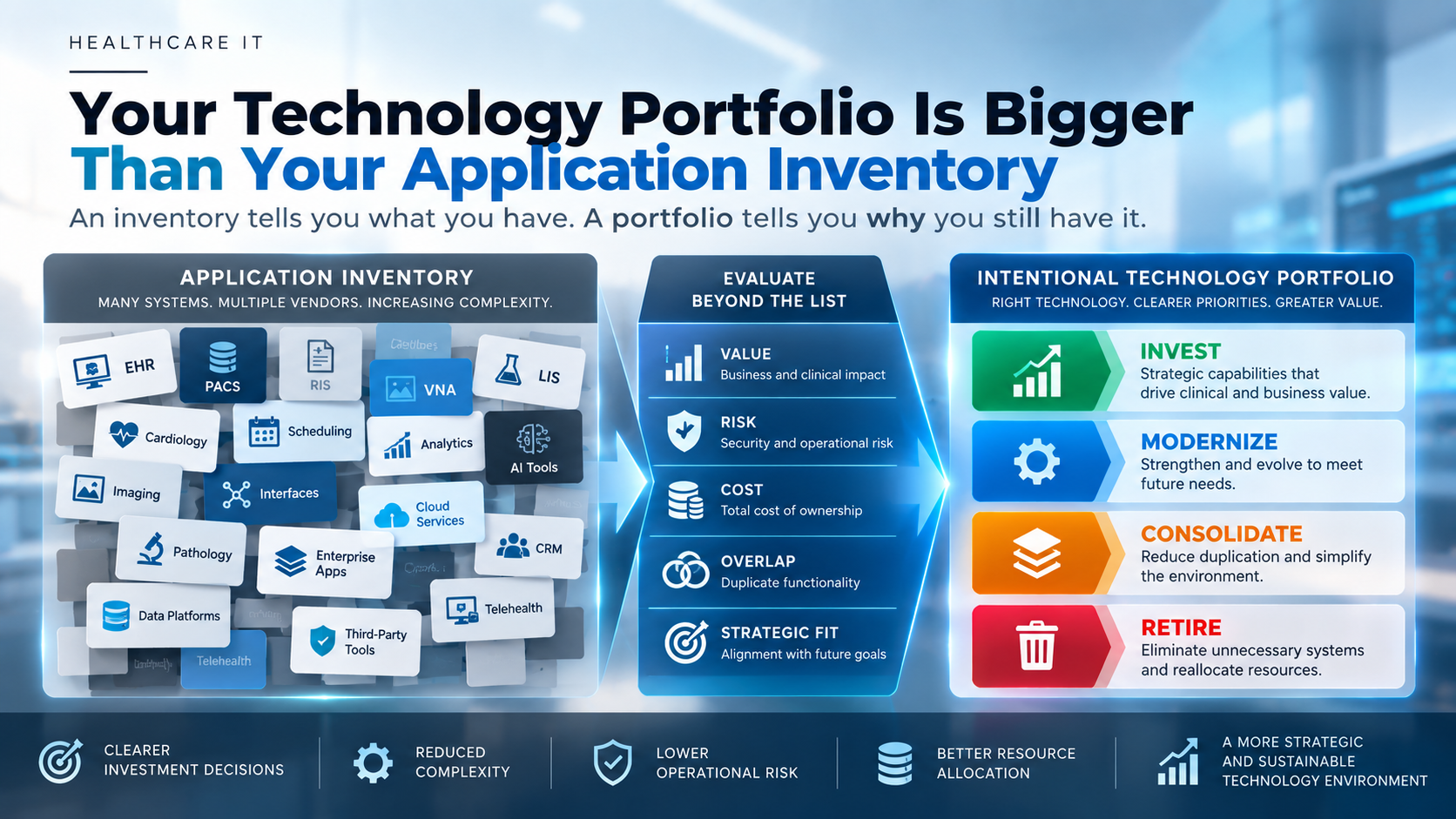
Your Technology Portfolio Is Bigger Than Your Application Inventory
Healthcare organizations often have a detailed application inventory.
They know the system name, vendor, version, owner, renewal date, and perhaps the department using it.
That information is important.
But an application inventory is not a technology portfolio.
An inventory tells you what you have.
A portfolio should help you decide what you should do with it.
The Difference Matters
Healthcare technology environments grow over time.
New applications are introduced to meet clinical needs. Departments purchase specialized systems. Acquisitions bring additional platforms. Temporary solutions become permanent. Older systems remain because replacing them feels more disruptive than keeping them.
Eventually, the organization may have hundreds of applications—but very little visibility into whether those applications still make sense collectively.
The problem is not necessarily that the inventory is incomplete.
The problem is that the inventory does not answer the questions leadership actually needs answered:
- What business or clinical capability does this system support?
- How much value does it provide?
- What does it cost to operate and support?
- What operational or cybersecurity risk does it introduce?
- Does another application already provide the same capability?
- How difficult is it to integrate and maintain?
- Does it align with the organization’s future architecture and strategy?
Those questions turn an inventory into a portfolio.
Every Application Should Have a Reason to Exist
Technology portfolios become difficult to manage when systems remain in the environment simply because they are already there.
A system may have an owner.
It may have a support team.
It may even have a current contract.
None of those things necessarily mean the organization should continue investing in it.
Every significant technology asset should have a clear reason for remaining in the portfolio.
That requires evaluating several dimensions together:
Value. What clinical, operational, financial, or strategic capability does the technology provide?
Risk. What happens if the system fails, becomes unsupported, experiences a security incident, or can no longer meet regulatory requirements?
Cost. What is the true cost beyond licensing—including infrastructure, interfaces, support resources, upgrades, cybersecurity controls, and operational complexity?
Overlap. Are multiple systems providing substantially similar capabilities?
Strategic fit. Does the technology support where the organization is going, or does it preserve an architecture the organization is trying to leave behind?
Looking at only one of these dimensions can produce the wrong decision.
A low-cost application may create significant integration risk.
A clinically valuable application may still require modernization.
An expensive platform may actually reduce total enterprise cost if it eliminates several redundant systems.
Portfolio management requires seeing those relationships.
The Goal Is Not Simply to Reduce Applications
Application rationalization is sometimes interpreted as a cost-cutting exercise.
That is too narrow.
The objective is not to eliminate as many systems as possible.
The objective is to make deliberate investment decisions.
For each major technology asset, leadership should ultimately be able to determine whether to:
Invest — because the platform is strategically important and deserves additional capability or adoption.
Modernize — because the capability remains valuable, but the underlying technology or architecture needs improvement.
Consolidate — because overlapping platforms can be reduced or standardized.
Retire — because the technology no longer provides enough value to justify its cost, complexity, or risk.
Those decisions cannot come from a spreadsheet containing application names and renewal dates alone.
They require governance, architecture, financial visibility, operational knowledge, and input from the people who actually depend on the technology.
Portfolio Management Is an Ongoing Discipline
A technology portfolio is not something an organization evaluates once every several years.
It changes continuously.
New applications are introduced.
Cloud services expand.
AI capabilities are embedded into existing platforms.
Vendors change product strategies.
Cybersecurity requirements evolve.
Clinical workflows change.
Mergers and acquisitions introduce additional technology.
Without an ongoing portfolio discipline, complexity begins rebuilding almost immediately after a rationalization initiative ends.
That is why portfolio management should become part of normal technology governance.
Major investments should be evaluated not only on their individual merits, but also on how they affect the broader enterprise portfolio.
Before introducing another system, organizations should be asking:
What capability are we adding—and do we already own it somewhere else?
That one question can prevent years of unnecessary complexity.
From Visibility to Decisions
Most healthcare organizations do not lack technology.
They lack a consistent mechanism for deciding where technology deserves continued investment.
A reliable application inventory creates visibility.
A technology portfolio creates decision-making capability.
The difference is significant.
When leadership can evaluate technology through value, risk, cost, overlap, and strategic fit, the conversation changes from:
“What systems do we have?”
to:
“Which technologies should we invest in, modernize, consolidate, or retire?”
That is where portfolio management begins delivering strategic value.