

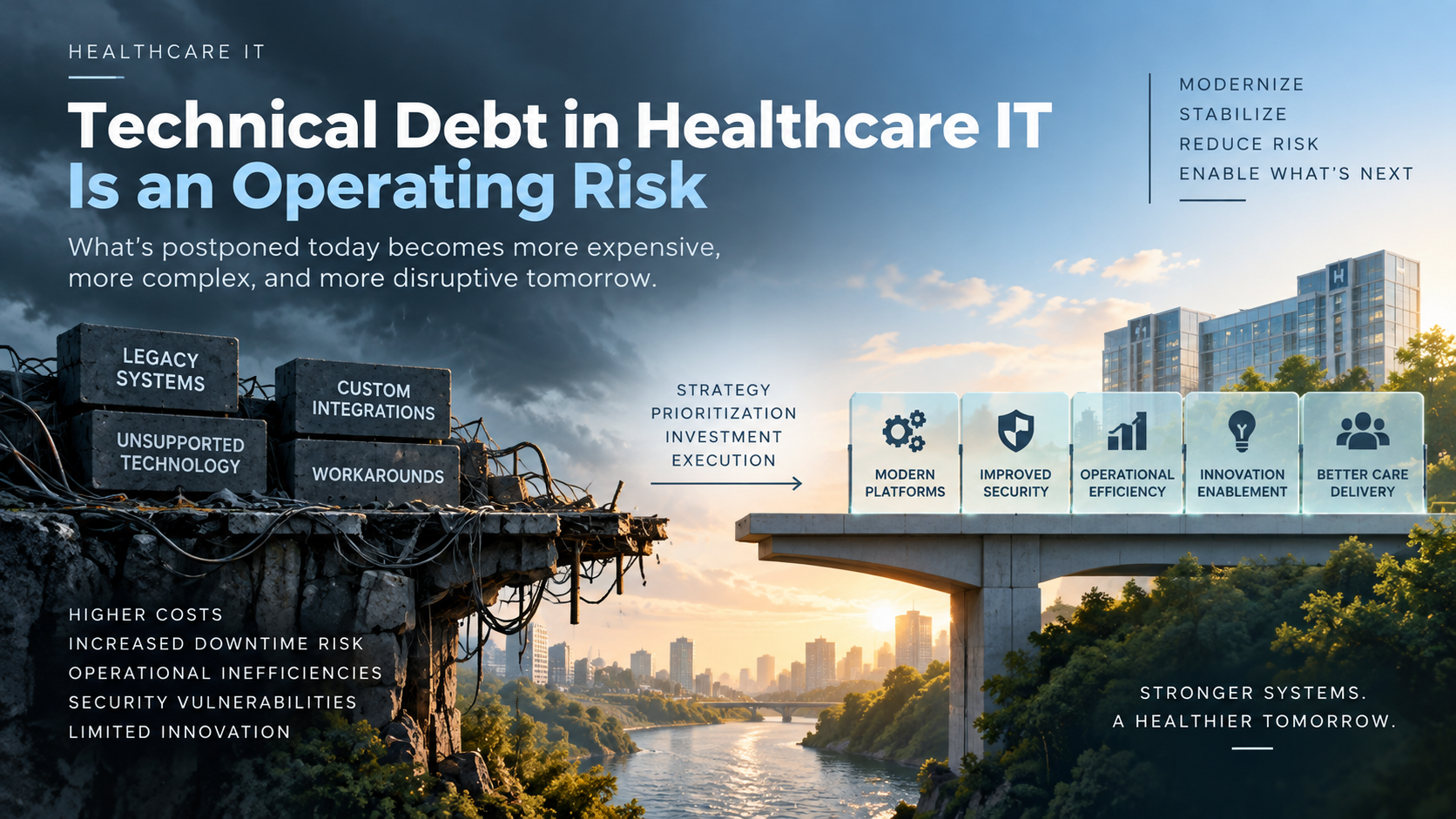
Healthcare organizations rarely choose technical debt intentionally.
It accumulates.
A temporary interface becomes permanent. A legacy application remains because replacing it is difficult. A customization survives long after the business requirement that created it. An unsupported server stays online because another system still depends on it. A manual workaround becomes part of the standard operating process.
Individually, each decision may appear reasonable.
Collectively, they can create an environment that is increasingly expensive, fragile, and difficult to change.
That is why healthcare leaders should stop viewing technical debt solely as an IT maintenance problem.
Technical debt is an operating risk.
Technical Debt Is More Than Old Technology
Age alone does not make a system technical debt.
A mature platform that remains supported, secure, reliable, and aligned with operational requirements may continue delivering significant value.
Technical debt emerges when technology begins imposing increasing constraints on the organization.
That may include:
- Unsupported or difficult-to-support applications
- Excessive customization
- Point-to-point interfaces that are difficult to maintain
- Manual processes created around system limitations
- Aging infrastructure
- Duplicate capabilities across platforms
- Poorly documented dependencies
- Vendor or technology constraints that prevent modernization
The issue is not simply that the technology is old.
The issue is the operational cost of keeping it the way it is.
The Cost Is Often Hidden
Technical debt does not always appear as a clear line item in the IT budget.
Its cost is distributed throughout the organization.
Teams spend additional hours troubleshooting fragile integrations.
Analysts maintain mappings and workarounds that should no longer be necessary.
Clinicians move between applications because information remains fragmented.
Infrastructure teams support platforms that require specialized knowledge.
Projects take longer because every change must account for years of accumulated dependencies.
These costs become normalized because people learn how to work around them.
But normalization does not eliminate the cost.
It simply makes it harder to see.
Reliability Becomes an Operational Issue
In healthcare, technology reliability has consequences beyond IT.
A failing interface can interrupt clinical workflow.
An unavailable imaging system can delay access to prior studies.
An aging application can create downtime risk.
An unsupported component can become a cybersecurity exposure.
A poorly understood dependency can turn a routine upgrade into an enterprise incident.
As environments become more interconnected, technical debt in one area can affect systems far beyond the original application.
That makes modernization more than a technology refresh.
It becomes part of operational resilience.
Technical Debt Also Limits Innovation
Organizations often discuss modernization in terms of what new technology they want to implement.
Cloud.
AI.
Advanced analytics.
Automation.
Digital patient experiences.
But every new capability must operate within the existing technology environment.
When that environment contains excessive technical debt, innovation becomes harder.
Teams spend more time integrating around legacy constraints.
Data remains difficult to access.
Security requirements become more complicated.
New platforms inherit old dependencies.
Implementation timelines expand.
Eventually, the organization may discover that its ability to adopt new technology is being constrained by decisions made years earlier.
The cost of technical debt is not only what it takes to maintain the past. It is also what it prevents the organization from doing next.
Not Every Debt Needs to Be Eliminated
The objective should not be to replace every legacy system.
That would be expensive, disruptive, and often unnecessary.
Technical debt needs to be managed as a portfolio.
Organizations should understand:
What debt exists?
What operational processes depend on it?
What is the cost of maintaining it?
What risks does it create?
What future initiatives does it constrain?
What happens if nothing changes?
Those questions allow leadership to distinguish tolerable debt from debt that requires action.
Some technology can remain.
Some should be stabilized.
Some should be consolidated.
Some should be modernized.
And some should be retired.
Prioritization Should Be Based on Business Impact
The loudest technical problem should not automatically become the highest modernization priority.
A better approach considers multiple dimensions:
Operational impact.
Clinical impact.
Cybersecurity exposure.
Supportability.
Cost.
Dependency complexity.
Downtime risk.
Strategic importance.
Innovation constraints.
This creates a more defensible modernization roadmap.
Instead of saying:
“This system is old, so we need to replace it.”
Leadership can say:
“This capability creates increasing operational risk, consumes disproportionate support resources, constrains strategic initiatives, and should therefore be addressed.”
That is a business conversation—not merely a technology conversation.
Modernization Requires More Than Replacement
Replacing an application does not automatically eliminate technical debt.
Organizations can migrate old complexity directly into a new platform.
Every customization is recreated.
Every exception is preserved.
Every historical workflow becomes a requirement.
The new environment then inherits much of the complexity of the old one.
Modernization should therefore ask:
What should we stop doing?
Which customizations still provide value?
Which workflows should be redesigned?
Which integrations can be standardized?
Which applications can be consolidated?
Which data should move?
Which dependencies should disappear entirely?
A modernization program should reduce complexity—not simply relocate it.
Make Technical Debt Visible
Organizations cannot manage technical debt effectively if leadership cannot see it.
Technical debt should become part of enterprise technology planning, architecture governance, investment decisions, and operational risk discussions.
That does not require turning every technical issue into an executive escalation.
It requires creating visibility into the areas where accumulated technology decisions are materially affecting reliability, cost, security, workforce capacity, or strategic execution.
Once visible, technical debt can be prioritized.
Once prioritized, it can be managed deliberately rather than addressed only when something fails.
Technical Debt Is a Leadership Decision
Every organization will carry some technical debt.
The goal is not zero debt.
The goal is intentional debt—technology constraints the organization understands, accepts, monitors, and eventually addresses according to business priorities.
The danger is unmanaged debt that quietly grows until modernization becomes urgent, expensive, and disruptive.
Healthcare leaders therefore need to ask more than:
“Is the system still running?”
They should also ask:
“What is it costing us to keep it running—and what is it preventing us from doing next?”
Because what is postponed today does not disappear.
It becomes tomorrow’s operating risk.
At InsightBridge Technologies, we help healthcare organizations evaluate technology portfolios, enterprise architecture, clinical systems, imaging platforms, interoperability, and modernization priorities so technology investments reduce operational risk while creating a stronger foundation for what comes next.