

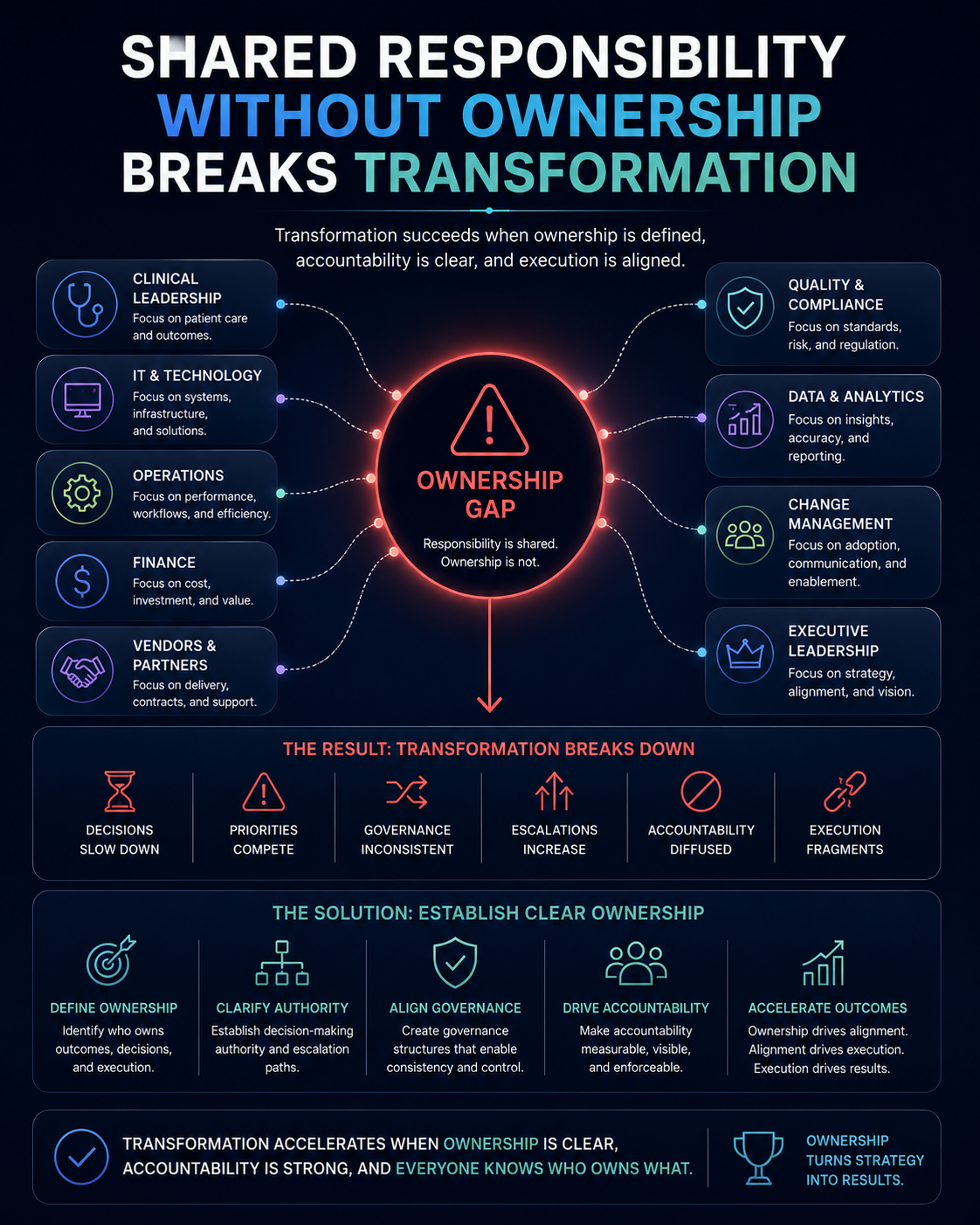
Large-scale healthcare transformation initiatives rarely fail because organizations lack talent, technology, or investment.
More often, they fail because accountability is distributed while ownership remains unclear.
Transformation efforts typically involve multiple departments, stakeholders, vendors, and leadership teams.
Everyone participates.
But when operational ownership is not clearly defined, execution begins to fragment.
Decisions slow down.
Priorities compete.
Governance becomes inconsistent.
Escalations increase.
And accountability becomes difficult to enforce across the enterprise.
Over time, organizations experience a common pattern:
Shared responsibility without clear ownership.
In these environments, transformation initiatives become operationally complex long before they become technically complex.
Organizations that scale successfully approach this differently.
They define ownership early.
They establish governance structures that clarify decision-making authority, operational accountability, and enterprise alignment across clinical, operational, and IT functions.
They create operating models in which accountability is measurable and execution responsibilities are clearly understood.
This becomes increasingly important in enterprise imaging, AI adoption, interoperability, and cloud transformation initiatives — where success depends on coordinated execution across highly interconnected environments.
Technology alone cannot create alignment.
Operational ownership does.
Transformation accelerates when organizations move beyond participation and establish true accountability structures.
Because in enterprise transformation, responsibility shared by everyone often becomes ownership held by no one.